

Fake review manipulation is defined as the coordinated practice of posting fabricated, paid, or AI-generated ratings to deceive consumers into purchasing products they would otherwise reject. Spotting fake tech reviews online has become a core consumer skill in 2026, particularly after the FTC introduced rules in 2024 making fake reviews explicitly illegal. Platforms like Amazon, TikTok Shop, and Google Reviews remain heavily affected, with up to 43% of reviews on some Amazon bestsellers showing signs of inauthenticity. That number means nearly half of what you read before clicking “buy” could be manufactured. Tools like Fakespot, once a go-to browser extension for detecting suspicious reviews, have since been discontinued, leaving consumers to rely on sharper reading skills and smarter cross-platform habits.
How to spot fake tech reviews online: the red flags that matter
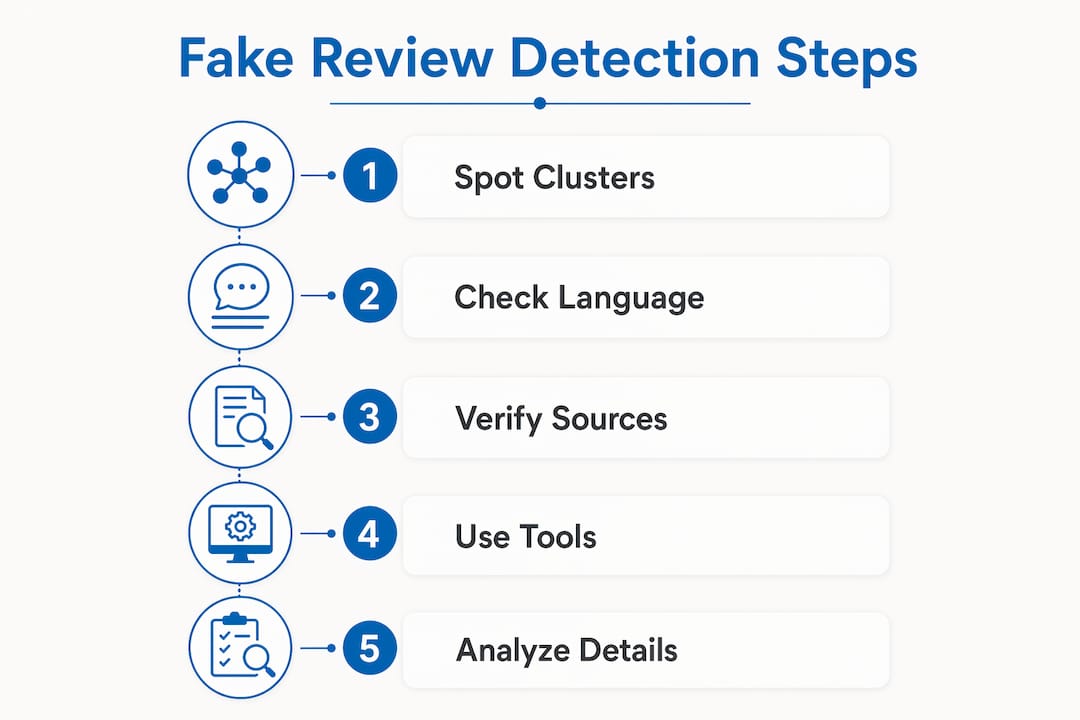
The clearest signal of review manipulation is timing. When 50 or more five-star reviews appear within a 48-hour window, that pattern almost never reflects organic buyer behavior. Real reviews accumulate gradually, spread across days and weeks as products ship and users settle into them. A sudden burst of identical ratings points to a coordinated campaign, not genuine satisfaction.
Language is the second giveaway. AI-generated fake reviews rely on polished, repetitive phrasing that reads more like marketing copy than a real person’s experience. Phrases like “exceeded all my expectations” or “absolutely love this product” appear across dozens of reviews with no variation in structure. Genuine users describe specific moments: a laptop fan that ran loud during a video call, a keyboard that felt mushy after two weeks, or a charging cable that frayed at the connector. Fake reviews skip those details entirely.

Profile behavior reveals a lot too. Review-only accounts that have posted 30 or 40 five-star ratings across unrelated product categories, all within a few months, are almost certainly part of a paid reviewer network. Check the profile photo as well. A reverse image search on Google Images or TinEye can confirm whether a profile picture is a stock photo or an AI-generated face, both of which are common in fake reviewer setups.
Here are the core red flags to watch for when reading tech reviews:
- A cluster of five-star reviews posted within 24 to 48 hours of each other
- Generic, polished language with no mention of specific product features or real-world use
- Long, glowing multi-paragraph reviews that read more like press releases than personal accounts
- Reviewer profiles with no purchase history outside of five-star ratings
- Excessive emojis or repeated use of the exact product name, which signals keyword stuffing scripts
- Zero negative feedback across an entire product listing, which is statistically implausible for any real product
Pro Tip: Read the two-star and three-star reviews first. They tend to be the most honest, containing the kind of nuanced trade-offs that neither a paid promoter nor an angry returner would bother writing.
How do you verify tech reviews across multiple platforms?
Cross-referencing is the most reliable method for understanding review authenticity. Third-party platforms like Reddit, Trustpilot, and the Better Business Bureau sit outside the seller’s control, which means brands cannot filter or suppress what users post there. A product with 4.8 stars on Amazon but a thread full of overheating complaints on Reddit’s r/laptops is telling you something the star rating is not.
Here is a practical verification sequence you can run before any significant tech purchase:
- Search the product name plus the word “problems” or “issues” on Reddit and YouTube. Real hardware failures surface quickly in community discussions.
- Check Trustpilot and the BBB for the brand itself, not just the product. Patterns of complaint about customer service or warranty handling reveal systemic issues.
- Look at the one-star and two-star reviews on the retailer’s own page. Read them for specific, repeatable complaints rather than vague frustration.
- Search YouTube for hands-on video reviews posted at least 60 days after the product launched. Post-hype reviews tend to be more measured and accurate.
- Look for independent tech blog coverage from writers who disclose affiliate relationships clearly. Affiliate link disclosures help you judge how much financial motivation shapes the review’s tone.
One thing worth understanding is that the “Verified Purchase” badge on Amazon does not guarantee a genuine, uncompensated review. Rebate scams allow paid reviewers to buy a product, receive a full refund through a third-party site, and still qualify for the badge. The badge confirms a transaction happened. It does not confirm the reviewer was honest or unpaid.
Pro Tip: When searching for real user experiences, try the exact model number plus the word “experience” in quotes on Google. This surfaces forum posts and community threads that product-focused searches often miss.
What tools and manual checks can you use to detect dishonest tech reviews?
The loss of Fakespot, which was acquired by Mozilla and then shut down in 2024, left a real gap in the consumer toolkit. It had been one of the most accessible ways to run an automated authenticity check on Amazon listings. Today, the most reliable approach combines a few remaining tools with a disciplined manual checklist.
For manual review vetting, work through these checks systematically:
- Review date analysis: Sort reviews by most recent and look for date clusters. Organic reviews spread out; coordinated ones bunch together.
- Language originality: Paste a suspicious review into a search engine in quotes. If the same phrasing appears across multiple listings or products, it is almost certainly templated.
- Photo and video scrutiny: Genuine user photos show real environments, wear, and context. Stock-looking images with perfect lighting and no background clutter are a warning sign.
- Sentiment balance: The absence of negative reviews is itself a red flag. Every real product has trade-offs, and genuine buyers mention them.
- Reviewer profile depth: Click through to the reviewer’s profile. A real buyer usually has a mix of ratings, product categories, and review lengths.
On the tool side, ReviewMeta remains active and works specifically on Amazon listings, grading reviews by adjusting the star rating to exclude suspicious entries. The result is a “adjusted rating” that often tells a very different story than the displayed average.
| Check method | What it reveals | Limitation |
|---|---|---|
| ReviewMeta analysis | Adjusted star rating after filtering suspicious reviews | Amazon only |
| Reddit and forum search | Real user complaints and hardware issues | Requires manual effort |
| Reverse image search | Fake or stock profile photos | Does not catch AI-generated faces reliably |
| Date cluster analysis | Coordinated review campaigns | Requires sorting by date manually |
| Affiliate disclosure check | Financial bias in tech blog reviews | Only works if disclosure is present |
Reviewers using excessive emojis or repeating the full product name multiple times in a single review are almost always following a spam script designed to boost keyword rankings. That pattern is easy to spot once you know to look for it.
Pro Tip: Genuine reviews almost always mention at least one specific component or feature by name, such as the battery life after a firmware update or the trackpad feel after a month of use. If a review never gets that specific, treat it with skepticism.
How fake review strategies affect your tech buying decisions
Between 30 and 40 percent of reviews on major retail platforms show signs of inauthenticity. That scale means the problem is not isolated to sketchy off-brand sellers. It affects flagship products from well-known manufacturers on the most trafficked pages of the internet’s largest retailers.
Review farms operate as organized businesses. They recruit reviewers through private Facebook groups, Telegram channels, and dedicated websites, offering free products or cash payments in exchange for positive ratings. Some brands go further and actively suppress negative reviews by flagging them as policy violations or routing unhappy customers to private support channels before they can post publicly.
The result is what I’d call a review echo chamber. A product accumulates hundreds of five-star ratings, each one reinforcing the others, until the sheer volume creates a false sense of consensus. Shoppers assume that 4,000 positive reviews cannot all be wrong. In reality, they can.
A few habits help you avoid getting caught in that echo chamber:
- Wait at least 60 to 90 days post-launch before trusting a product’s review profile. Initial launch periods attract the most coordinated fake activity.
- Seek out reviews from hobbyists and enthusiast communities rather than relying solely on mainstream retail pages.
- Cross-check hobbyists, journalists, and user communities to build a rounded picture of real-world performance.
- Treat a perfect five-star average with the same suspicion you would give a zero-star average. Neither reflects reality.
- Look for reviews that mention product limitations alongside strengths. Balanced reviews with negative feedback expose more truth than uniformly glowing ones.
Affiliate-driven tech blogs add another layer of complexity. When a site earns a commission on every sale it drives, the financial incentive to emphasize positives and downplay negatives is real. That does not make every affiliate review dishonest, but it does mean you should weigh disclosures carefully and look for sites that test products independently before recommending them.
Key takeaways
Recognizing fake tech reviews requires combining pattern recognition, cross-platform verification, and a healthy skepticism toward both perfect ratings and suspiciously timed review surges.
| Point | Details |
|---|---|
| Timing clusters signal fraud | Fifty or more five-star reviews within 48 hours almost always indicate coordinated manipulation. |
| Generic language is a red flag | AI-generated reviews lack specific product details and repeat polished phrases across listings. |
| Verified Purchase is not proof | Rebate scams allow paid reviewers to earn the badge without genuine, uncompensated use. |
| Cross-platform research is non-negotiable | Reddit, Trustpilot, and YouTube surface real complaints that seller-controlled pages suppress. |
| Wait before you buy | Post-launch reviews after 60 to 90 days are significantly more reliable than day-one ratings. |
Why I think most consumers are still reading reviews wrong
I’ve spent years reading tech reviews across dozens of platforms, and the honest truth is that most people still anchor on the star rating before reading a single word. That instinct is exactly what fake review operations exploit. The number is designed to be the first thing your eye lands on, and once you see 4.7 out of 5, your brain starts looking for confirmation rather than contradiction.
What I’ve found actually works is reading in reverse. Start with the three-star reviews. They are almost always written by people who bought the product with genuine enthusiasm, ran into real limitations, and still found enough value to avoid returning it. That combination produces the most honest writing you will find anywhere on a product page.
I also think the shutdown of Fakespot was a bigger loss than most people realize. It lowered the barrier for casual shoppers to run a quick authenticity check without needing to know what to look for manually. The gap it left has not been filled, and that puts more responsibility on individual consumers to develop their own critical reading habits.
My practical advice: treat any review that does not mention a single flaw as promotional content until proven otherwise. Real users find flaws. They always do. And when you find a reviewer who calls out a specific issue, say a laptop’s thermal throttling under sustained load or a pair of earbuds that loses Bluetooth connection when your phone is in your pocket, that specificity is worth more than 500 five-star ratings combined. You can find that kind of honest, hands-on analysis at Techreviewnerds, where the goal has always been to tell you what a product is actually like to live with.
Report suspected fake reviews when you see them. Amazon, Google, and the FTC all have reporting mechanisms. It takes two minutes and it genuinely helps clean up the ecosystem for everyone.
— K
Find trusted tech reviews that actually tell you the truth
If you have spent time wading through suspicious five-star ratings and polished promotional copy, you already know how exhausting it is to find a review you can actually trust.

Techreviewnerds publishes independent, hands-on reviews based on real-world use, with no paid placements and no hidden affiliate pressure shaping the conclusions. Whether you are looking for the right laptop for daily work, school assignments, or weekend gaming sessions, the site’s best laptops for 2026 guide cuts through the noise with practical comparisons built on genuine testing. Every recommendation comes with honest trade-offs, because that is what actually helps you decide.
FAQ
What makes a tech review fake?
A fake tech review is one that is paid, AI-generated, or posted by an incentivized reviewer rather than a genuine, uncompensated buyer. Key signs include generic language, timing clusters, and reviewer profiles with no purchase history outside of five-star ratings.
Are verified purchase reviews trustworthy?
Not always. Rebate scams allow paid reviewers to purchase a product, receive a refund through a third-party site, and still earn the Verified Purchase badge. The badge confirms a transaction but does not confirm the reviewer was honest or unpaid.
Which platforms are best for finding real tech reviews?
Reddit, Trustpilot, and YouTube are the most reliable sources because they sit outside seller control. Searching a product name plus “problems” or “issues” on Reddit surfaces real user complaints that retailer pages often suppress.
How long should I wait before trusting a product’s reviews?
Waiting 60 to 90 days after a product launches gives the review profile time to stabilize beyond the initial wave of coordinated or hype-driven ratings. Post-launch reviews reflect real-world use rather than promotional momentum.
What happened to Fakespot?
Fakespot was acquired by Mozilla and subsequently shut down in 2024, removing one of the most accessible automated tools for detecting suspicious Amazon reviews. ReviewMeta remains an active alternative for Amazon listings, offering an adjusted star rating that filters out likely fake entries.