
For most creators, the Shure SM7B is the best overall microphone for untreated home studios and broadcast-style voice work, while the Blue Yeti remains the top plug-and-play USB pick for streamers and podcasters who want zero setup friction. At Techreviewnerds, we tested these models with real voice recordings across both treated and untreated rooms to give you picks grounded in actual performance—not spec sheets.
TL;DR shortlist:
- Best overall (untreated rooms): Shure SM7B (~$399) — dynamic, XLR, rejects room noise better than any condenser at this price
- Best USB plug-and-play: Blue Yeti (~$129) — multi-pattern condenser, works out of the box for streaming and podcasting; see our full Blue Yeti review
- Best budget: Fifine K669B — USB condenser, surprising clarity for its budget price
- Best hybrid USB/XLR: Shure MV7 — voice-tailored dynamic with an upgrade path built in
- Best for home studio vocals: Rode NT-USB — warm, low-noise USB condenser for treated spaces
- Best entry-level XLR condenser: Audio-Technica AT2020 — flat response, reliable build, pairs well with a budget interface
As MusicRadar notes, there is no single best mic for every task. The right choice depends on your source, room, and workflow. These picks reflect that reality.
Table of Contents
- What are the best microphones right now?
- Which microphone fits your specific use case?
- How do you choose the right microphone?
- What do mic types and polar patterns actually mean for your recordings?
- How Techreviewnerds picked and tested these microphones
- Key Takeaways
- The mic advice most guides get wrong
- Further reading and sources
- Techreviewnerds covers more than just microphones
What are the best microphones right now?
| Mic | Best For | Type | Connectivity | Price (USD) | Sound Character | Controls | Compatibility | Accessories / Extras Needed |
|---|---|---|---|---|---|---|---|---|
| Blue Yeti | Streaming, podcasting | Condenser | USB | ~$129 | Warm, full-bodied | Gain, mute, 4 patterns | Windows/macOS, plug-and-play | Desktop stand included |
| Rode NT-USB | Home studio vocals | Condenser | USB | ~$169 | Warm, detailed | Gain, headphone mix | Windows/macOS, plug-and-play | Pop filter included |
| Shure MV7 | Podcasting, streaming | Dynamic | USB + XLR | ~$249 | Warm, voice-focused | Gain, mute, touch panel | Windows/macOS, plug-and-play | None required; interface for XLR |
| Audio-Technica AT2020 | Budget studio tracking | Condenser | XLR | ~$99 | Flat, neutral | None onboard | Windows/macOS | Interface, shock mount, pop filter |
| Audio-Technica AT2020USB+ | Home studio, USB users | Condenser | USB | ~$149 | Flat, neutral | Headphone volume, mix | Windows/macOS, plug-and-play | Pop filter recommended |
| HyperX QuadCast | Gaming, streaming | Condenser | USB | ~$139 | Bright, present | Gain, mute, 4 patterns | Windows/macOS, plug-and-play | Integrated shock mount |
| Shure SM7B | Broadcast, untreated rooms | Dynamic | XLR | ~$399 | Warm, smooth | Low-cut, presence boost | Windows/macOS | Interface + clean preamp required |
| Fifine K669B | Budget podcasting | Condenser | USB | ~$30 | Decent, slightly bright | Volume knob | Windows/macOS, plug-and-play | Desktop stand included |
| Fifine K780A | Budget streaming | Condenser | USB | ~$50 | Clear, mid-forward | Gain, mute | Windows/macOS, plug-and-play | Desktop stand included |
| Maono PD200X | Budget hybrid creators | Dynamic | USB + XLR | ~$60 | Warm, controlled | Gain, mute | Windows/macOS, plug-and-play | None required |
| Maono PD400X | Streamers, podcasters | Condenser | USB + XLR | ~$80 | Bright, detailed | Gain, mute, RGB | Windows/macOS, plug-and-play | None required |
| Maono HD300T | Budget USB creators | Dynamic | USB | ~$50 | Warm, broadcast-style | Gain, mute | Windows/macOS, plug-and-play | Desktop arm recommended |
| Marantz Professional MPM-U | Home recording, budget | Condenser | USB | ~$60 | Neutral, clean | None onboard | Windows/macOS, plug-and-play | Pop filter recommended |
| CAD U37 | Beginners | Condenser | USB | ~$45 | Warm, slightly colored | None onboard | Windows/macOS, plug-and-play | Pop filter recommended |
| Blue Yeti Nano | Compact podcasting | Condenser | USB | ~$99 | Warm, focused | Gain, mute, 2 patterns | Windows/macOS, plug-and-play | Desktop stand included |
| Blue Snowball iCE | Entry-level streaming | Condenser | USB | ~$49 | Bright, clear | None onboard | Windows/macOS, plug-and-play | Desktop stand included |
| Blue Nessie | Casual creators | Condenser | USB | ~$99 | Warm, adaptive | Adaptive filter | Windows/macOS, plug-and-play | Desktop stand included |
| Samson Meteorite | Casual voice, calls | Condenser | USB | ~$35 | Decent, mid-focused | None onboard | Windows/macOS, plug-and-play | Fold-flat stand included |
| Apogee MiC 96k | Mobile, high-fidelity | Condenser | USB | ~$199 | Detailed, transparent | Gain knob | Windows/macOS/iOS | Lightning/USB-C cable |
| Shure MV5 | Compact podcasting | Condenser | USB | ~$99 | Warm, smooth | Gain, mute | Windows/macOS, plug-and-play | Desktop stand included |
| Shure MV51 | Home studio, instruments | Condenser | USB | ~$199 | Full, detailed | Gain, mute, EQ presets | Windows/macOS, plug-and-play | Desktop stand included |
| Cyber Acoustics CVL Rainier | Budget classroom/calls | Condenser | USB | ~$40 | Decent, functional | None onboard | Windows/macOS, plug-and-play | Desktop stand included |
Short reviews and accessory notes:
The Blue Yeti remains the benchmark for USB condensers because its four pickup patterns (cardioid, omni, figure-8, stereo) cover almost every desktop scenario without touching a driver. The main tradeoff is its size and sensitivity to room noise. If your space is untreated, it will pick up every HVAC hum. Our Blue Yeti vs. other USB mics comparison breaks down when it still makes sense in 2026.
The Shure SM7B is the workhorse for anyone recording in a spare bedroom or home office. Its dynamic design rejects room reflections in ways no condenser at this price can match. The catch: it needs a clean, high-gain preamp. A Focusrite Scarlett Solo or a Cloudlifter CL-1 are the standard pairings.
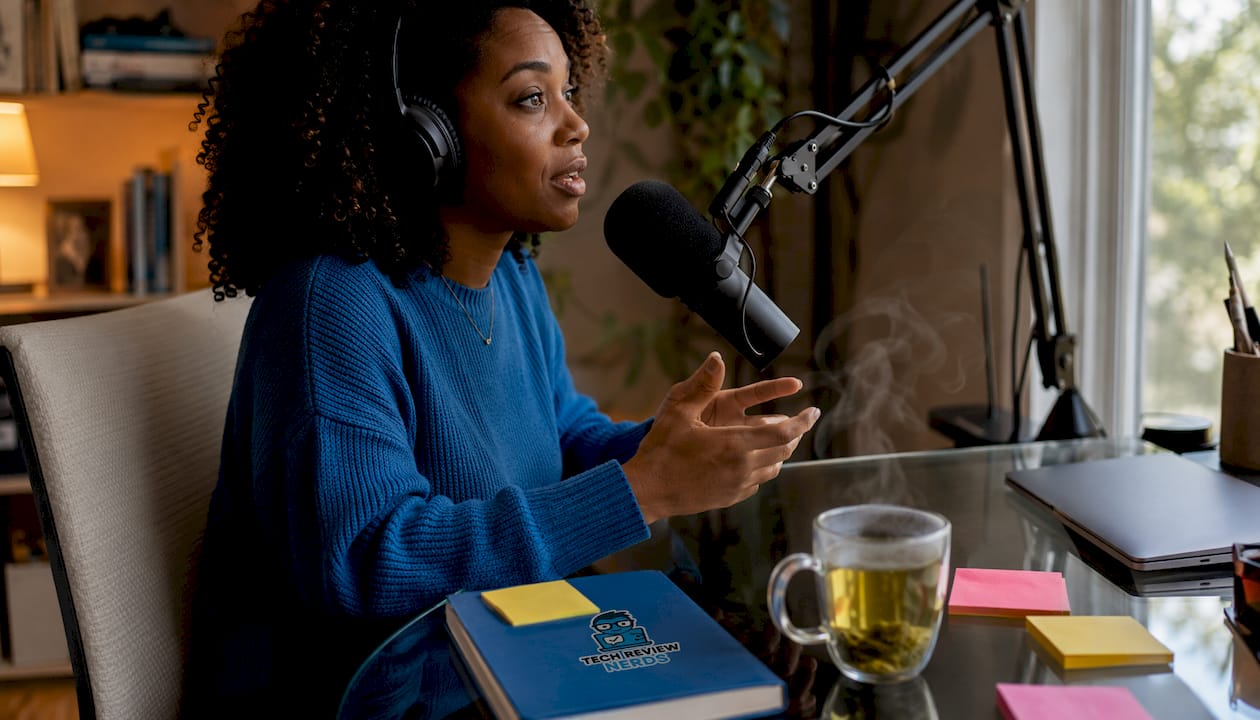
The Shure MV7 splits the difference. Its hybrid USB/XLR connectivity means you can start with a laptop and migrate to an interface later without buying a new mic. The internal preamp is solid for USB use, though the XLR output benefits from an external interface.
The Rode NT-USB is the best USB condenser for treated spaces. Its low self-noise and warm tonal balance make it a genuine studio tool in a plug-and-play body. The included pop filter and headphone monitoring jack add real value at the price.
Budget picks like the Fifine K669B, Maono PD200X, and CAD U37 all deliver workable audio for under $60. None of them will embarrass you on a podcast. The Maono PD200X is the most versatile of the three because its hybrid connectivity gives you a future upgrade path.
Which microphone fits your specific use case?
Podcasting
- Shure SM7B (XLR, ~$399) — The standard for a reason. Untreated rooms, loud HVAC, thin walls: the SM7B handles all of it. Pair it with a Focusrite Scarlett interface.
- Shure MV7 (USB/XLR, ~$249) — The smarter starting point if you are not ready to invest in an interface yet. The voice-tailored voicing sounds polished straight from USB.
- Rode NT-USB (USB, ~$169) — Best for podcasters in a quiet, treated space who want warmth without buying an interface.
Streaming
- Blue Yeti (USB, ~$129) — Multi-pattern flexibility and a desktop footprint that works for most streaming setups. Check our streaming microphone guide for room-specific advice.
- HyperX QuadCast (USB, ~$139) — The integrated shock mount and tap-to-mute button make it genuinely practical for live streaming. Bright sound character suits spoken commentary.
- Fifine K780A (USB, ~$50) — For budget streamers who want a mute button and decent clarity without spending $100+.
Vocal tracking (home studio)
- Audio-Technica AT2020 (XLR, ~$99) — The flat, neutral response is ideal for tracking vocals you plan to process in a DAW. Needs an interface, shock mount, and pop filter.
- Audio-Technica AT2020USB+ (USB, ~$149) — Same capsule, USB convenience, with a headphone monitoring jack for zero-latency monitoring.
- Apogee MiC 96k (USB, ~$199) — For creators who want the best analog-to-digital conversion in a USB form factor. The 96 kHz sample rate gives you headroom for post-processing.
Acoustic instruments
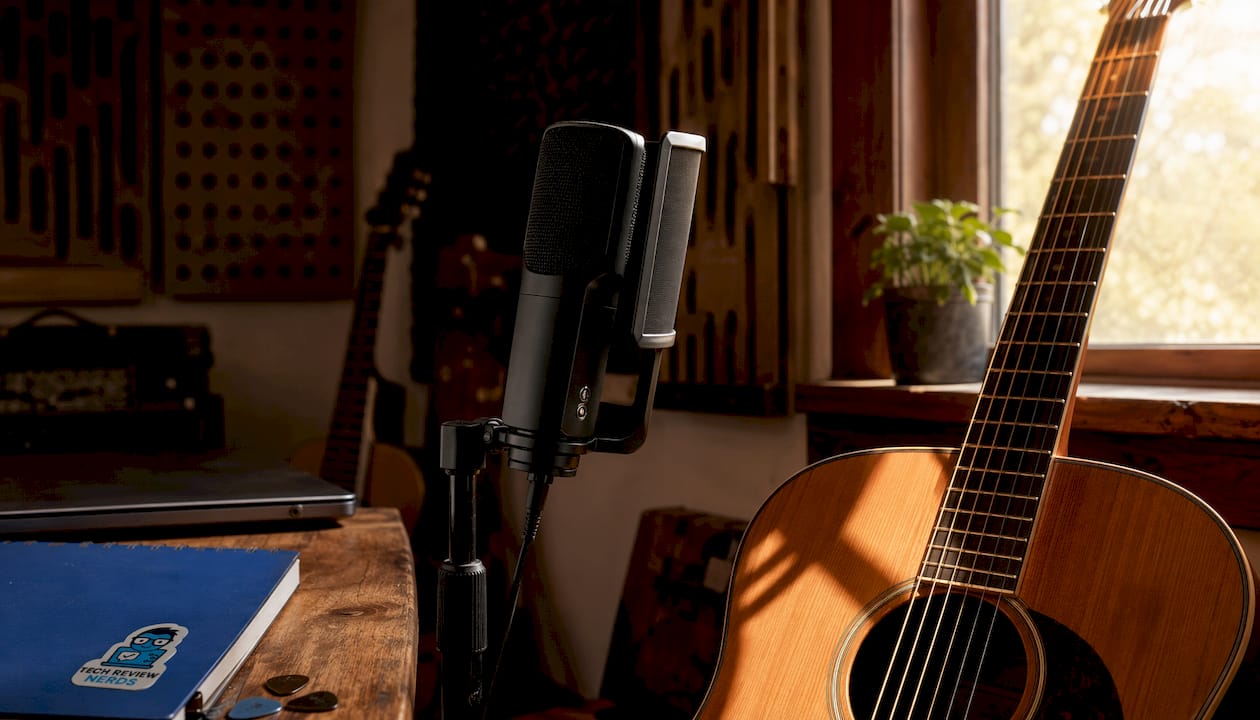
The Shure MV51 (~$199) and Rode NT-USB (~$169) both handle acoustic guitar well in a treated room. For XLR setups, the AT2020 is the go-to budget small-diaphragm-style condenser for guitar and light percussion.
Budget first mic
The Fifine K669B (~$30) is the easiest recommendation for anyone who just wants to start. The Blue Snowball iCE (~$49) adds a bit more clarity. For a step up with an upgrade path, the Maono PD200X (~$60) is the pick.
How do you choose the right microphone?
The single most important question is not “which mic sounds best?” It is “what does my room sound like?” Condensers reveal room problems; dynamics hide them. That one distinction changes the entire recommendation.
Buyer checklist:
- Is my room treated (acoustic panels, soft furnishings) or untreated (bare walls, hard floors)?
- What is my primary source: voice, acoustic instrument, or electric instrument?
- Do I need plug-and-play USB, or am I willing to buy an audio interface?
- What is my total budget, including accessories (interface, stand, pop filter)?
- Will I need phantom power (required for most XLR condensers)?
- Do I plan to upgrade my signal chain in the next 12–18 months?
Red flags when shopping:
- No published sensitivity or self-noise specs on the product page
- Frequency response graphs that show only a flat line (real mics have character)
- No warranty information or manufacturer support contact
- Suspiciously low prices on XLR condensers with no brand history
Pro Tip: In an untreated room, a $100 dynamic mic will almost always sound better than a $300 condenser. The condenser will capture every flutter echo and HVAC hum with perfect clarity. The dynamic will focus on your voice and ignore the rest.
Accessories you actually need:
- XLR condenser (AT2020, NT1): audio interface, boom arm or desk stand, pop filter, shock mount
- XLR dynamic (SM7B): audio interface with high gain or a preamp booster (Cloudlifter), boom arm
- USB condenser (Blue Yeti, Rode NT-USB): pop filter, boom arm (optional but recommended)
- Hybrid (Shure MV7, Maono PD200X): nothing for USB; interface for XLR mode
For a full beginner setup breakdown, the streaming gear guide for beginners covers everything from mic to interface to monitoring.
What do mic types and polar patterns actually mean for your recordings?
Dynamic vs. condenser vs. ribbon
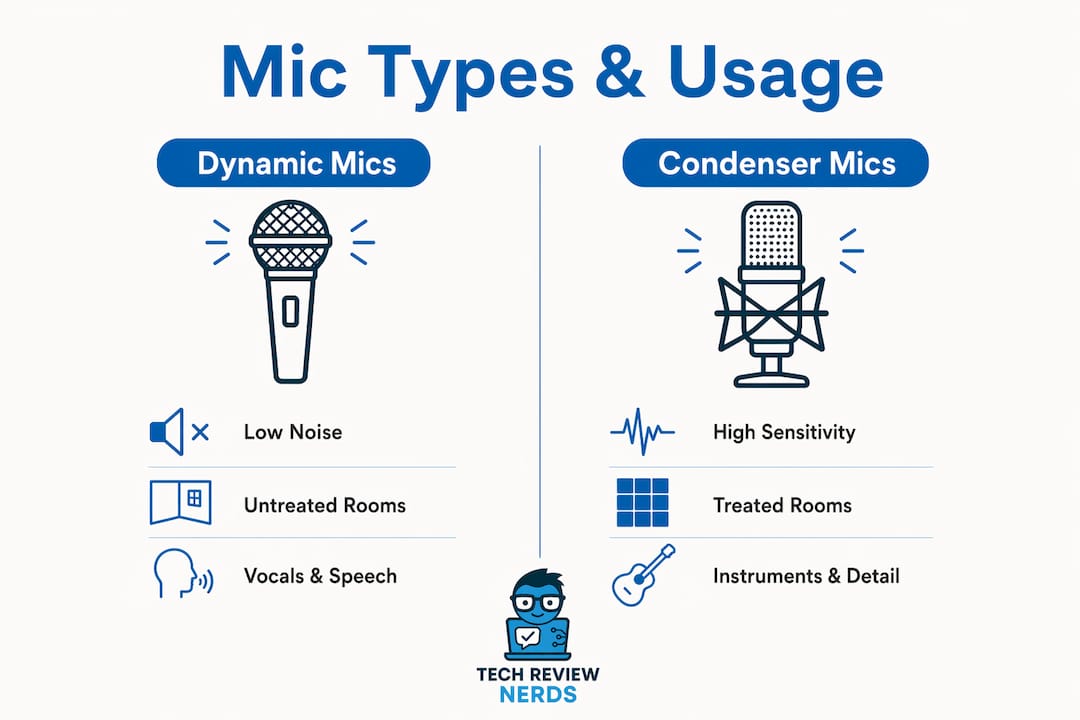
Dynamic microphones use a moving coil to convert sound. They are less sensitive, which means they reject background noise and handle loud sources well. That lower sensitivity is exactly why they work in untreated rooms. The SM7B and Shure MV7 are both dynamic.
Condenser microphones use a charged capacitor plate. They are more sensitive, capture more detail, and reveal room acoustics with precision. In a treated studio, that sensitivity is an asset. In a spare bedroom, it becomes a liability. The Blue Yeti, AT2020, and Rode NT-USB are all condensers.
Ribbon microphones use a thin metallic ribbon suspended in a magnetic field. They produce a warm, natural sound with a figure-8 polar pattern. They are fragile and expensive, which is why none of the budget picks here are ribbons.
Polar patterns in plain language
| Pattern | What it captures | Best for |
|---|---|---|
| Cardioid | Front only | Solo voice, podcasting, streaming |
| Supercardioid | Narrow front | Loud stages, isolation booths |
| Omnidirectional | All directions equally | Room ambience, roundtable podcasts |
| Figure-8 | Front and rear, rejects sides | Two-person interviews, stereo recording |
| Multi-pattern | Switchable | Versatile desktop use (Blue Yeti) |
Sensitivity, self-noise, and frequency response
Sensitivity tells you how much output voltage the mic produces from a given sound pressure level. Higher sensitivity means the mic picks up quieter sounds, but also more room noise. Self-noise (measured in dB-A) is the noise the mic’s own electronics add to the signal. Anything under 20 dB-A is quiet enough for most recording. The Rode NT-USB sits around 16 dB-A, which is genuinely low for a USB mic.
Frequency response describes how the mic handles different frequencies. A flat response (like the AT2020) is neutral and lets you shape the sound in post. A presence peak around 5–10 kHz (like many vocal condensers) adds air and clarity but can sound harsh on bright voices.
Use-case mapping:
| Mic type | Polar pattern | Room condition | Ideal sources |
|---|---|---|---|
| Dynamic | Cardioid | Untreated | Voice, podcasting, broadcast |
| Large-diaphragm condenser | Cardioid | Treated | Vocals, acoustic guitar |
| Small-diaphragm condenser | Cardioid | Treated | Acoustic instruments, drum overheads |
| USB condenser | Cardioid | Semi-treated | Streaming, podcasting, voice calls |
| Ribbon | Figure-8 | Treated | Vocals, brass, room ambience |
How Techreviewnerds picked and tested these microphones
Every mic in this roundup was evaluated through real-world voice and instrument recordings, not just spec comparisons. Testing covered both untreated rooms (standard home office with hard surfaces) and semi-treated spaces (soft furnishings, basic acoustic panels). All recordings used a consistent gain staging approach with a Focusrite Scarlett 2i2 for XLR mics and direct USB connections for USB models, monitored through the same headphone chain throughout.
A/B comparisons were run at matched levels, with particular attention to self-noise at low-gain settings, proximity effect behavior, and how each mic handled plosives without a pop filter. Mic performance varies significantly with gain requirements and room conditions, which is why we weighted real-room behavior more heavily than anechoic chamber specs.
Build quality and onboard controls were assessed for daily use: how easy is the mute button to hit accidentally? Does the gain knob introduce noise when adjusted? Does the shock mount actually isolate handling vibration? For live and broadcast contexts, capsule consistency and rugged build are the criteria that matter most over time.
Affiliate disclosure: Techreviewnerds earns a commission on purchases made through links in this article. Products were sourced at retail or on loan from manufacturers. Audio sample files are available on request via the contact page.
Key Takeaways
The most important decision in any microphone purchase is matching the mic type to your room: a dynamic mic in an untreated space will almost always outperform a condenser at twice the price.
| Point | Details |
|---|---|
| Room acoustics come first | In untreated rooms, dynamics like the SM7B reject reflections better than any condenser at the same price. |
| USB vs. XLR tradeoff | USB mics are plug-and-play but lock you into a fixed signal chain; XLR mics let you upgrade preamps and interfaces over time. |
| Best budget entry point | The Fifine K669B (~$30) and Maono PD200X (~$60) deliver workable audio for beginners without a large upfront investment. |
| Hybrid mics offer flexibility | The Shure MV7 and Maono PD200X support both USB and XLR, giving you an upgrade path without replacing the mic. |
| Techreviewnerds picks | For plug-and-play streaming, the Blue Yeti leads; for untreated home studios, the SM7B is the top recommendation from our testing. |
The mic advice most guides get wrong
Most microphone roundups lead with the most expensive or most recognizable name and work backward to justify it. The Neumann U 47 is genuinely legendary, and the AKG C12 VR has been called the holy grail of microphones by sound engineers for decades. But recommending either to a podcaster in a spare bedroom is not helpful advice. It is aspirational content dressed up as a buying guide.
The more useful truth is that consistency and reliability matter more than marginal sonic improvements in most real-world recording situations. The Shure SM7B became a broadcast standard not because it is the most detailed microphone ever made, but because it sounds predictably good across a wide range of voices and rooms without requiring a treated studio. That is the quality most creators actually need.
I’d also push back on the idea that USB mics are a compromise. For a creator who records in a living room and publishes weekly, a Rode NT-USB or a Blue Yeti is a completely legitimate long-term solution. The upgrade path to XLR matters only if you are genuinely planning to invest in a treated space and a quality interface. If you are not, the USB convenience is a feature, not a limitation.
What I’d encourage you to do: record a 60-second voice clip in your actual recording space before buying anything. Play it back and listen for room noise, flutter echo, and HVAC hum. That 60 seconds will tell you more about which mic category you need than any spec sheet.
Further reading and sources
These are the core sources used for picks, technical explanations, and testing methodology in this article. Where roundups conflict, we weighted primary testing data and room-condition guidance over brand reputation.
- Best microphones for recording 2026 | MusicRadar — Broad roundup with source-matching guidance
- Best studio microphones 2026 | SolderMag — Dynamic vs. condenser room guidance
- Microphone types: What mic do I need? | SoundGuys — USB vs. XLR signal chain explainer
- Best microphones for home studio 2026 | MusicProductionWiki — Untreated room dynamics guidance
- Grammy awards backed by Shure | FOHOnline — Live broadcast reliability and consistency
- AKG C12 VR product page | AKG — Reference for “holy grail” mic context
- Best vocal mics 2026 | MusicRadar — Stage and studio vocal mic guidance
Conflicting test results between roundups usually come down to room conditions and gain staging. When two sources disagree on a mic’s noise floor, check whether they tested in a treated or untreated space. Our methodology section above explains how we controlled for those variables.
Techreviewnerds covers more than just microphones
If you found this guide useful, the same approach — real-world testing, honest tradeoffs, no paid placements — applies across everything Techreviewnerds covers. Microphones are one piece of a creator or home-office setup, and the decisions around laptops, interfaces, and accessories are just as consequential.
For readers building out a full setup, the product buying guides section covers how to evaluate reviews and comparisons across categories, so you can apply the same critical lens to every purchase. If you are shopping for the laptop that will run your DAW or streaming software, the 2026 laptop buying guide walks through the specs that actually matter for audio and video work. Browse the full tech gadgets category for curated picks across productivity, gaming, and media.
What is the highest quality microphone available?
There is no single microphone that is best for all tasks; the highest quality depends on matching the mic to your source, room, and workflow. Studio classics like the Neumann U 47 and AKG C12 VR are legendary in treated studios, but for most creators, dynamic models such as the Shure SM7B or USB options like the Rode NT-USB balance quality and practicality at accessible prices.
Which microphone brand do most professional singers use?
Shure, Neumann, and AKG dominate professional vocal recording and live performance. The Shure SM7B is among the most widely used broadcast and stage vocal mics, while Neumann large-diaphragm condensers are standard in major recording studios.
Is the Blue Yeti still worth buying in 2026?
Yes, for plug-and-play USB streaming and podcasting. Its four pickup patterns and simple desktop controls make it one of the most versatile USB mics available, though it picks up room noise in untreated spaces. See the full Blue Yeti review for a detailed breakdown.
Should I buy a USB or XLR microphone?
USB mics are the right choice if you want plug-and-play convenience and do not plan to upgrade your signal chain. XLR mics let you improve sound over time by upgrading your interface and preamp, making them the better long-term investment if you are serious about audio quality.
What microphone works best in an untreated room?
A dynamic microphone, such as the Shure SM7B or Shure MV7, is the standard recommendation for untreated rooms because its lower sensitivity rejects background noise and room reflections that a condenser would capture clearly.
Recommended
- How to Choose the Right Microphone for Streaming or Podcasting – Tech Review Nerds
- Best Blue Yeti Alternatives for Streaming and Podcasting (2026) – Tech Review Nerds
- Best USB Microphone Under $150 for Streaming and Zoom Calls: Logitech Blue Yeti USB Microphone – Tech Review Nerds
- Logitech Blue Yeti USB Microphone – Tech Review Nerds