
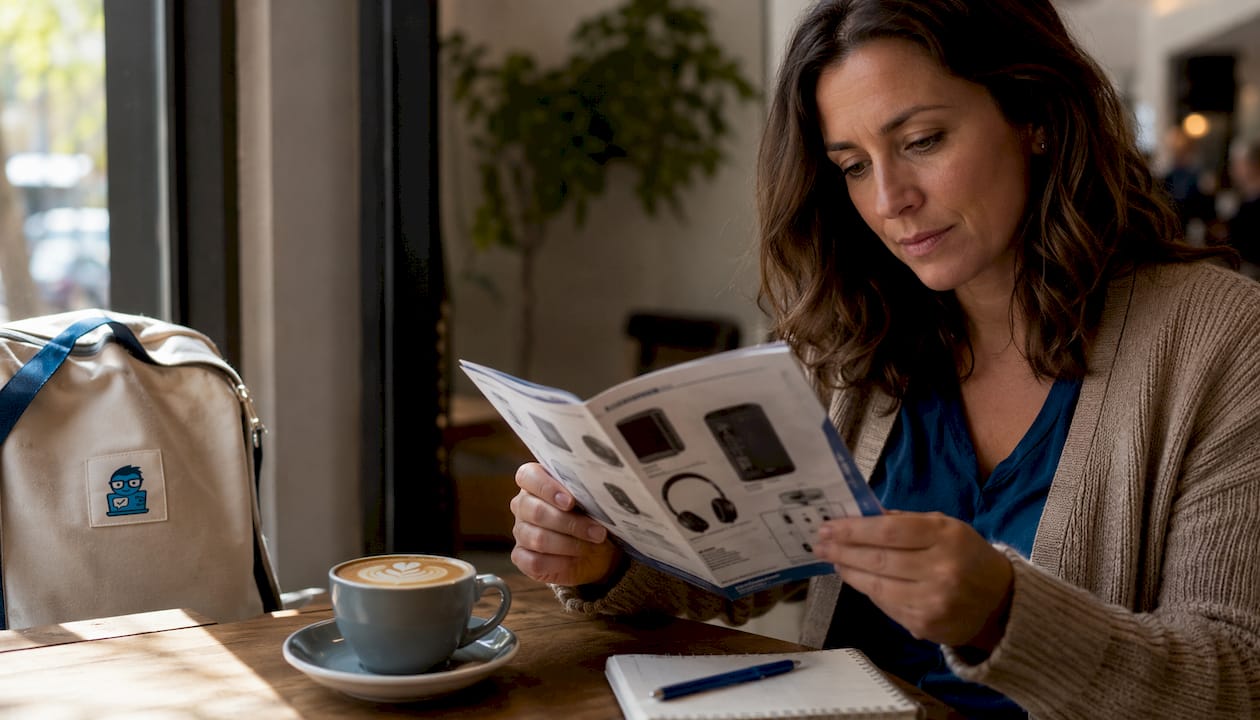
A product buying guide is a buyer-centered, long-form resource designed to reduce uncertainty and support confident purchasing decisions. Unlike a product brochure, which is written from the seller’s perspective, a good buying guide puts the reader’s decision first. It explains trade-offs, defines key criteria, and helps you compare realistic options before you ever talk to a salesperson. Think of it as the knowledgeable friend who has already done the research and is walking you through what actually matters.
The best guides share a handful of consistent traits:
- They define who the guide is for and what buying situation it addresses
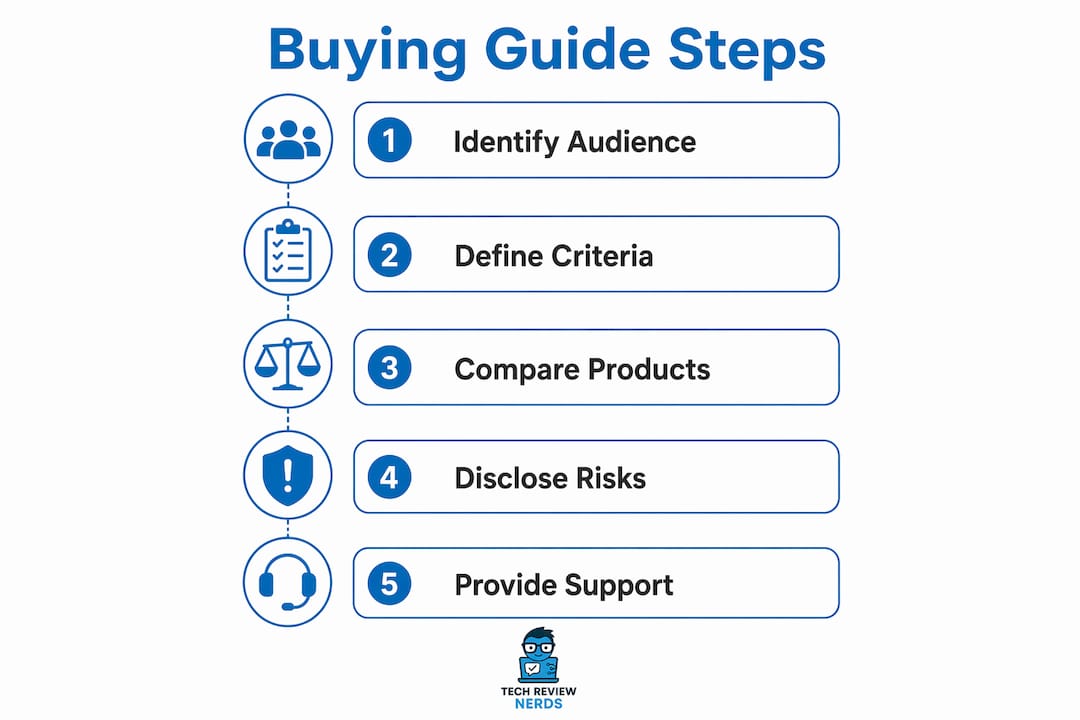
- They list clear decision criteria (price, features, support, risk, compatibility)
- They compare realistic options with honest trade-offs, not just the “best” path
- They include questions you can ask vendors before committing
- They cover costs, implementation, and what happens after you buy
- They provide a clear next step so you know what to do when you finish reading
Whether you’re shopping for a laptop, a home appliance, or a B2B software platform, buyer’s guides serve the same core function: they give you a decision framework rather than a sales pitch.
7 examples of product buying guides worth learning from
Real-world examples reveal what separates a genuinely useful guide from a polished brochure. These seven stand out for clarity, structure, and reader focus.
1. Good Housekeeping’s appliance guides
Good Housekeeping’s research arm, the Good Housekeeping Institute, physically tests every product it reviews before publishing. Its food processor guide, for instance, walks readers through bowl capacity, motor wattage, blade types, and cleaning ease before recommending specific models. The credibility comes from the lab work, not just the writing. That testing-first approach is something most online guides skip entirely.
2. REI’s outdoor gear guides
REI labels its buying guides under “Expert Advice,” which is a smart trust signal. The guides are written by gear specialists who explain the difference between insulation types, fit systems, and activity-specific use cases. What makes them work is specificity: rather than saying “look for a warm jacket,” REI tells you exactly which fill power rating suits which temperature range. That level of detail gives readers real decision-making power.
3. Best Buy’s electronics buying guides
Best Buy’s guides, including its Coffee Maker Buying Guide, are formatted for fast scanning rather than linear reading. Jump links, short paragraphs, and comparison tables let readers move directly to the section relevant to their situation. The format acknowledges that most readers don’t read top to bottom. For anyone thinking about how to choose gadgets, Best Buy’s structure is a practical template.
4. Consumer Reports’ category guides
Consumer Reports builds trust through independence. Its air purifier guide, for example, explains CADR ratings, filter types, and room-size compatibility before ranking products. Because Consumer Reports accepts no advertising from the brands it covers, readers treat its recommendations as genuinely neutral. That independence is the guide’s most valuable feature, and it’s something any guide creator should aim to replicate in tone, even without a formal testing lab.
5. Wirecutter-style deep-dive guides
Long-form guides that dedicate hundreds of words to a single product category, explain testing methodology, and acknowledge where a top pick falls short have become a trusted format. The key lesson: admitting a limitation builds more trust than pretending every option is perfect. Readers notice when a guide never says anything negative, and they stop believing it.
Pro Tip: If your guide never acknowledges a trade-off or a downside, readers will assume it’s a sales document and discount everything in it.
6. B2B managed services guides
In business-to-business buying, guides for managed IT services or facilities management often include stakeholder maps, sample timelines, and vendor question lists. These elements help buyers navigate internal approval processes, not just the product decision itself. A guide that helps you justify a purchase to your CFO is far more useful than one that only explains features.
7. Audio-enhanced buying guides
A growing format pairs an HTML guide page with an embedded audio version and a downloadable PDF. This approach serves readers who want to listen during a commute, scan on mobile, or print for a meeting. Offering multiple formats without duplicating content is a practical way to extend a guide’s reach without rebuilding it from scratch.
How to create a buying guide that readers actually use
Most buying guides fail not because the writing is bad but because they start from the wrong place. The product comes first, the reader comes second. Flip that, and the guide becomes genuinely useful.
-
Start with a real buying decision. Identify the specific situation your reader is in: replacing an aging device, scaling a business process, or making a first-time purchase. The buying situation shapes everything else.
-
Define who the guide is for. A first-time laptop buyer and an IT manager sourcing 50 units need completely different guides. Be specific about your reader’s experience level, budget range, and decision constraints.
-
List the key decision criteria. These are the factors your reader should use to compare options: price and pricing model, performance specs, support levels, compatibility, implementation time, and switching costs. Keep the list focused on what actually changes the decision.
-
Map out realistic options. Don’t just present your preferred solution. Compare in-house vs. outsourced, entry-level vs. professional-grade, or subscription vs. one-time purchase. Readers trust guides that acknowledge multiple valid paths.
-
Build a comparison table. A well-structured table lets readers evaluate options side by side without rereading paragraphs. Nielsen Norman Group’s guidance on comparison tables notes they work best when options and attributes are clear enough for quick scanning.
-
Include questions to ask vendors. Give readers something they can use in an actual conversation: What is included in the quoted price? Who handles implementation? What does onboarding require from our team? How do you handle escalation and response times?
-
Cover costs and risks honestly. Address upfront cost, ongoing cost, hidden cost, switching cost, and the cost of doing nothing. Readers who feel a guide is hiding the financial reality will stop trusting it immediately.
-
Write with a consultative tone. The biggest failure in buying guides is pretending every path leads neatly to your product. Impartiality and clear trade-offs build trust. A guide that sounds like a sales pitch is a guide readers close.
-
Choose the right format. An HTML page is best for search visibility and mobile reading. A PDF works when buyers need to download, print, or share internally. Audio is a useful addition for readers who prefer to listen. Many guides benefit from offering all three.
-
Add a clear next step. Every guide should end with one specific action: book a consultation, compare your current setup, download a checklist, or view pricing. A guide without a next step leaves readers informed but directionless.
-
Track engagement, not just downloads. Most companies publish a PDF, count the downloads, and stop there. A download doesn’t prove the reader finished it or acted on it. Track scroll depth, CTA clicks, return visits, and audio completions to understand whether the guide is actually working.
What every buyer’s guide should include
The structure of a buying guide matters as much as the content inside it. Readers who can’t find what they need quickly will leave, regardless of how thorough the writing is.
Audience and buying situation up front. The first two or three paragraphs should tell readers exactly who the guide is for and what decision it supports. This helps readers self-qualify and helps anyone sharing the guide internally route it to the right person.
Decision criteria, not just features. Features describe what a product does. Decision criteria help readers decide which features matter for their situation. The distinction is subtle but important. A guide that lists specs without explaining which specs matter for which use case is just a product sheet with better formatting.
A comparison table. Standardized tables let readers evaluate options without holding multiple paragraphs in their head simultaneously. Keep the attributes consistent across all options so the comparison is genuinely fair.
Risk disclosures and trade-offs. Effective buying guides help buyers act like stakeholders by surfacing trade-offs even when those trade-offs reflect poorly on a preferred option. Speed vs. control, cost vs. scalability, flexibility vs. simplicity. These are the real decisions buyers face, and a guide that ignores them loses credibility fast.
Vendor questions. A list of questions buyers can bring to supplier conversations turns a passive reading experience into an active preparation tool. This is one of the most underused elements in most guides.
Post-purchase information. Including onboarding and support details reassures buyers who are anxious about long-term impact. What does implementation look like? How long does it take? Who do you call when something goes wrong? Mapping the post-purchase experience transforms a guide from a sales tool into a trusted resource.
Third-party validation. 79% of consumers read three or more reviews before making a purchase decision. A guide that integrates real customer feedback, independent ratings, or verified review data gives readers the social proof they’re already looking for. Treat reviews as a content element, not an afterthought.
Essential elements at a glance:
- Clear audience and buying situation statement
- Key decision criteria (not just feature lists)
- Honest comparison table with consistent attributes
- Trade-off analysis and risk disclosures
- Vendor question list
- Cost breakdown (upfront, ongoing, hidden, switching)
- Post-purchase and onboarding expectations
- Third-party reviews or independent validation
- A single, clear next step
How 2026 consumer behavior is reshaping buying guides
The way people research purchases has shifted in ways that directly affect what a buying guide needs to do. The data from 2026 is clear: buyers are more deliberate, more skeptical, and more likely to cross-check everything you tell them.
Nearly two-thirds of U.S. consumers (64%) now use AI tools to research purchases, up from 45% in 2025. Of those, a significant portion say AI has expanded the number of sources they consult, not narrowed it. That means your buying guide is no longer competing with a few alternatives. It’s competing with an AI-assisted research process that pulls from dozens of sources simultaneously.
60% of consumers now spend more time researching before they commit to a purchase. The window to influence a decision is longer than it used to be, but also more competitive. A guide that only covers specs won’t hold attention through an extended research process. Utility, relevance, and honest trade-off analysis are what keep readers engaged long enough to act.
“Buying is no longer a funnel, it is an evaluation. Consumers cross-check brand claims against reviews, search results, marketplaces, and AI assistants before they ever hit ‘add to cart.’” — Emplifi, 2026 Consumer Research
AI transparency has become a purchase criterion in its own right. Buyers expect brands to disclose when AI is used in marketing, customer service, or content creation. Guides that use AI-generated content without disclosure risk losing the trust they’re trying to build. Pairing any AI-assisted content with human expertise and real customer voices keeps credibility intact.
The research window for high-ticket purchases has also widened. For anything priced above $500, 56% of buyers visit three or more websites before deciding. At $1,000 and above, that figure rises to 63%. A buying guide for a high-consideration product needs to assume the reader is simultaneously checking your claims against at least two other sources. Consistency, transparency, and third-party validation aren’t optional at that price point.
Guides that explicitly teach readers how to verify claims using independent sources build trust faster than those that simply assert authority. Pointing readers toward real-world testing reviews or explaining how to spot credible sources turns your guide into a research partner rather than just another voice competing for attention.
Pro Tip: Treat your review section as performance content. Collect reviews at every post-purchase moment, surface them on product pages and in guides, and let your customers do the talking where brand-authored claims would feel self-serving.
At Techreviewnerds, I’ve spent a lot of time working through what makes a buying guide actually worth reading versus one that just takes up space on a product page. The guides that hold up are the ones built around the reader’s decision, not the seller’s agenda. If you’re shopping for tech and want guides that reflect genuine hands-on experience rather than spec-sheet summaries, the laptop buying guide and the laptops section at Techreviewnerds are good places to start.
Key Takeaways
A well-built product buying guide reduces purchase uncertainty by centering the reader’s decision, not the seller’s product, and backing every claim with honest trade-offs and third-party validation.
| Point | Details |
|---|---|
| Buyer-centered structure | Start with the reader’s buying situation and decision criteria, not the product’s features. |
| Honest trade-offs build trust | The biggest failure in buying guides is pretending every path leads to your product; impartiality wins. |
| Third-party validation matters | 79% of consumers read three or more reviews before deciding, so integrate real social proof. |
| AI has expanded research scope | 64% of U.S. consumers use AI for purchase research in 2026, consulting more sources than ever before. |
| Track engagement, not downloads | Scroll depth, CTA clicks, and audio completions reveal whether a guide is actually working. |
FAQ
What are buying guides?
A buying guide is a decision-support resource that helps consumers understand what to look for before they buy. It explains decision criteria, compares realistic options, covers costs and risks, and provides a clear next step.
Are buyer’s guides legitimate?
Yes, when created by reputable sources with genuine expertise or independent testing. The reliability of a buying guide depends on its source. Trustworthy guides are typically produced by organizations or reviewers with deep category knowledge and no financial stake in steering you toward a specific product.
What are the different types of buyer’s guides?
The main types include category guides (covering an entire product class), product-specific guides (focused on one item or brand), and comparison guides (evaluating multiple options side by side). Format also varies: HTML pages for search and mobile, PDFs for sharing internally, and audio versions for on-the-go research.
Is it “buyer’s guide” or “buyers guide”?
Both spellings are widely used and accepted. “Buyer’s guide” (with the apostrophe) is the more grammatically precise form, indicating a guide belonging to or made for the buyer. “Buyers guide” appears frequently in commercial and digital publishing contexts and carries the same meaning.
How do you spot a credible buying guide?
Look for clear disclosure of who created it and how, honest acknowledgment of trade-offs and limitations, integration of independent reviews or third-party data, and a tone that helps you decide rather than pushes you toward one outcome. Guides that never say anything negative about any option are usually brochures in disguise.