
Consumer electronics are electronic devices designed for everyday personal, family, or household use. Under 15 USC 2301), a “consumer product” is any tangible personal property distributed in commerce and normally used for personal, family, or household purposes. The U.S. Department of Energy further clarifies this in the Energy Policy and Conservation Act, distinguishing consumer products from commercial equipment based on the type of use, not just who buys them.
Modern home electronics span a wide range of categories:
- Communication devices: smartphones, tablets, laptops, desktop computers
- Entertainment systems: flat-screen TVs, streaming devices, gaming consoles, Blu-ray players
- Smart home technology: voice assistants, smart thermostats, connected lighting, security cameras
- Wearables: smartwatches, fitness trackers, wireless earbuds
- Productivity tools: printers, monitors, computer accessories
- Emerging devices: AI-enabled smart glasses, augmented reality headsets
What separates today’s devices from those of a decade ago is the depth of software embedded in them. AI features, subscription services, and cloud connectivity are now core parts of the product, not afterthoughts bolted on after the hardware ships.
How consumer electronics evolved from radio sets to AI devices
The consumer electronics industry traces its roots to early 20th-century radio broadcasting, which produced the first mass-market electronic product: the broadcast receiver. From there, the category expanded steadily through each decade.
Key milestones in the evolution of home electronics:
- 1920s–1940s: Radio receivers become household staples; early televisions emerge
- 1950s–1960s: Black-and-white TV adoption surges; transistor radios shrink portable audio
- 1970s–1980s: VCRs, calculators, and early personal computers enter homes
- 1990s: CD players, DVD players, and mobile phones go mainstream
- 2000s: MP3 players, flat-panel TVs, and broadband internet reshape consumption
- 2010s: Smartphones, tablets, smart TVs, and voice assistants converge into one ecosystem
- 2020s: AI integration, 5G connectivity, and software-service bundles define the product experience
One distinction worth knowing: historically, audio and video devices were called “black goods” because of their dark casings, while major appliances like washing machines and refrigerators were called “white goods.” In British English, the audio-visual category was often labeled “brown goods.” Since the 2010s, big-box retailers have largely collapsed this distinction, stocking entertainment devices, home appliances, and office tech side by side.
The shift from analog to digital was the single biggest structural change the industry went through. It opened the door to software updates, app ecosystems, and the kind of connected experiences that define the latest gadgets on shelves today.
What product categories make up today’s consumer electronics market?
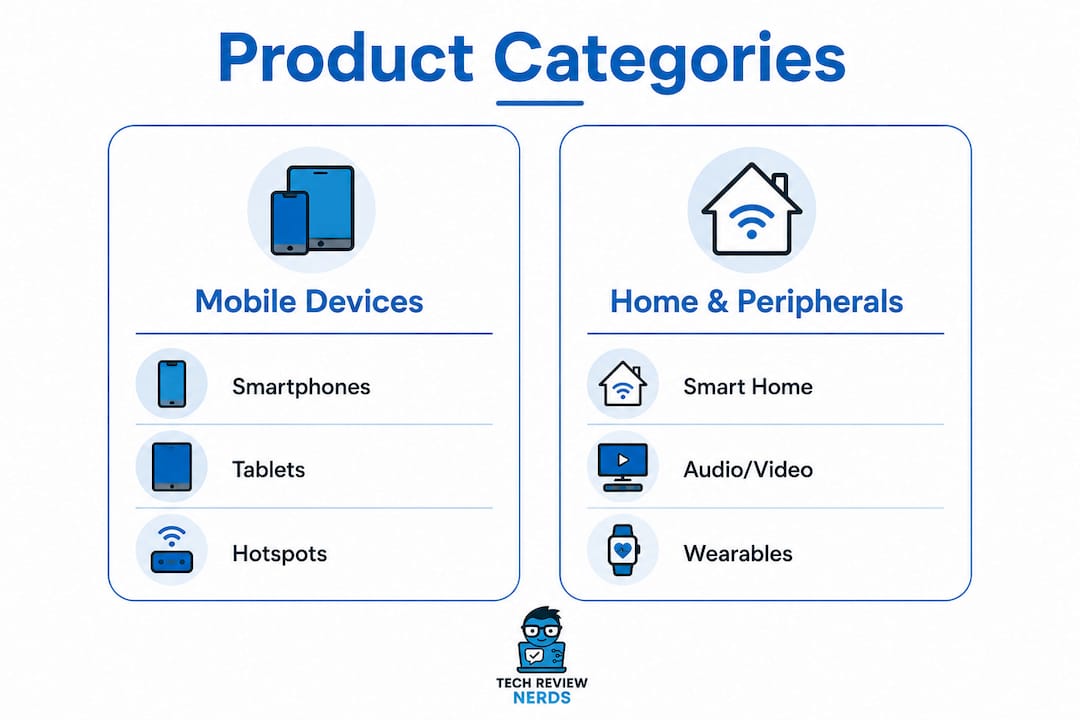
The modern market breaks into several well-defined categories, each with its own use cases and buying considerations.
Mobile devices sit at the center of most people’s tech lives. Smartphones, tablets, and portable hotspots handle communication, navigation, photography, and entertainment. Apple leads U.S. smartphone shipment share as of Q1 2026, followed by Samsung and Motorola, with 5G rollout continuing to drive upgrade cycles.

Computers and peripherals cover laptops, desktops, monitors, keyboards, and storage devices. This category powers both remote work and creative production. If you’re evaluating options here, Techreviewnerds publishes hands-on laptop reviews that cut through spec sheets and focus on real-world performance.
Audio and video hardware includes wireless audio devices like Bluetooth speakers and noise-canceling headphones, soundbars, home theater systems, and 4K or 8K televisions. This is where premium pricing has accelerated fastest, as buyers trade up for Dolby Atmos support and OLED display quality.
Smart home devices connect thermostats, door locks, security cameras, and lighting into a single app-controlled system. The smart home setup guide at Techreviewnerds walks through how to build and secure one of these systems from scratch.
Wearables and health tech span smartwatches, fitness bands, continuous glucose monitors, and hearables. Health tracking has moved from novelty to daily habit for millions of users.
Gaming consoles and accessories remain a high-engagement category, with current-generation hardware pushing real-time ray tracing and 120Hz output as baseline expectations.
Emerging categories include AI-enabled smart glasses, mixed-reality headsets, and AI-powered home hubs. These are still early-adoption products, but they’re moving faster than tablets did at the same stage.
How the consumer electronics industry is structured
The industry runs on a layered supply chain. Semiconductor manufacturers produce the chips that power everything. Component suppliers provide displays, batteries, and sensors. Original equipment manufacturers (OEMs) assemble finished products, often under brand names that handle their own marketing and distribution.

Key players in the U.S. market by estimated market share in weight include Samsung Electronics America at 17.08%, HP Inc. at 10.69%, LG Electronics USA at 9.21%, TCL North America at 9.14%, and VIZIO at 5.54%, according to 2026 market share data.
The Consumer Technology Association (CTA) is the primary industry standards body in the United States. It sets technical standards, publishes annual forecasts, and organizes CES, the world’s largest consumer technology trade show. CTA’s forecasts carry real weight because they aggregate data across the full supply chain, not just retail sales.
Retail distribution splits between physical and digital channels. Big-box stores remain the dominant physical channel, while e-commerce has grown into the primary discovery and purchase path for many product categories. Direct-to-consumer sales through brand websites have also grown, particularly for premium audio and wearables.
The business model shift worth watching is the move toward software and services revenue. CTA forecasts hardware revenue growth of 3.4% in 2026, while software and services spending is projected to grow at 4.2%. Brands that lock users into subscription ecosystems, cloud storage plans, and premium feature tiers are generating recurring revenue that hardware margins alone cannot match.
Regulatory and sustainability requirements are reshaping manufacturing decisions too, from energy efficiency standards under EPCA to emerging right-to-repair legislation at the state level.
What does the U.S. consumer electronics market look like in 2026?
The headline number is $565 billion in projected U.S. consumer technology revenue for 2026, representing 3.7% year-over-year growth despite tariff pressures and broader economic uncertainty.
$565 billion — projected U.S. consumer technology revenue in 2026, with 3.7% year-over-year growth (CTA)
Unit shipment growth tells a different story. Volume is nearly flat at +0.7%, meaning revenue gains come almost entirely from higher prices and richer feature sets, not from selling more units. That’s the premiumization effect in action.
| Segment | Key Driver |
|---|---|
| Hardware revenue | AI-enabled devices, premium tiers |
| Software and services | Subscriptions, cloud features |
| Unit shipments | Flat volume, price-driven growth |
| Average device price | Increasing trend reflecting premium mix shift |
Circana industry advisor Paul Gagnon has described the spending pattern as “K-shaped”: high-income buyers are driving growth while lower-income consumers pull back. Average electronics prices are increasing, which compresses the affordable end of the market and pushes brands to justify premium pricing through AI features and software experiences.
YouGov data shows Samsung leads U.S. brand consideration across multiple product categories in 2026, with notable generational gaps: Gen Z and Gen X evaluate brand value quite differently, creating real divergence in how brands need to position themselves. Younger buyers prioritize cost efficiency and are more open to emerging brands, while older buyers lean toward established names with proven track records.
AI integration is the most discussed trend at the product level. Deloitte’s 2026 outlook points to AI-driven personalized systems and software-service bundles reshaping both device design and consumer expectations. The CTA frames this as a shift toward “premiumization,” where the value of a device increasingly lives in its software layer, not just its physical components.
What should you consider when buying consumer electronics in 2026?
Buying electronics in 2026 requires thinking beyond the spec sheet. The hardware is almost always good enough at a given price point. What separates a smart purchase from a frustrating one is everything around the hardware.
Key factors to evaluate before buying:
- Software longevity: How many years of OS updates and security patches does the manufacturer commit to? A device that loses support in two years is a liability.
- Data privacy and security: Does the device collect usage data? Can you opt out? Smart home devices in particular deserve scrutiny here.
- Repairability: Repairability scores have become mainstream purchasing criteria by 2026, influencing product design and marketing. A device with a score you can look up before buying is worth more than one you can’t.
- Total cost of ownership: Factor in subscription fees, accessories, and replacement costs, not just the sticker price.
- AI feature value: Not all AI features are equally useful. Ask whether the AI capability solves a real problem you have, or whether it’s a marketing checkbox.
- Durability ratings: IP ratings for water resistance and MIL-SPEC drop ratings matter if the device leaves your desk.
Deloitte’s consumer tech research confirms that durability, foundational features, and data privacy rank as top purchasing priorities across income levels in 2026. The K-shaped spending pattern means budget-conscious buyers are holding devices longer and expecting more from them.
Pro Tip: Before committing to any device with a subscription component, calculate the three-year total cost including the service fee. A $200 device with a $10/month subscription costs more over three years than a $400 device with no recurring fees.
For hands-on guidance across categories, Techreviewnerds covers tech gadgets for productivity, gaming, and media with real-use testing rather than spec comparisons alone.
How sustainable is the consumer electronics industry?
The environmental footprint of consumer electronics is larger than most buyers realize. The U.S. Energy Information Administration estimates that electronic devices account for roughly 10%–15% of energy use in American homes, and that figure climbs toward 50% of household consumption when major appliances are included.
E-waste is the other side of the problem. Most consumer devices contain materials that require specialized recycling, including lithium, cobalt, and rare earth elements. When devices end up in landfills, those materials are lost and potentially harmful. Manufacturer take-back programs and certified e-waste recyclers exist in most U.S. states, but participation rates remain low.
Right-to-repair legislation is changing the calculus for manufacturers. Several U.S. states have passed or are considering laws requiring brands to make spare parts and repair documentation available. The EU’s right-to-repair directive has already influenced how some global brands approach product design, and American consumers are starting to feel those effects. Repairability scores, once a niche concern for tech activists, now appear in mainstream product reviews and purchasing guides.
Energy efficiency standards under EPCA continue to tighten, pushing manufacturers to reduce standby power consumption and improve overall efficiency ratings. Buyers who prioritize Energy Star-certified devices reduce both their electricity bills and their environmental impact.
What regulatory and industry challenges does the sector face?
Tariffs are the most immediate pressure point in 2026. Trade policy uncertainty has raised component costs and complicated supply chain planning for brands that manufacture primarily in China. Most consumer electronics production is concentrated in cities like Shenzhen and Dongguan, and any disruption to that supply chain ripples quickly into retail pricing.
Antitrust scrutiny of major platform ecosystems is another live issue. When a smartphone OS controls app distribution, payment processing, and device integration, regulators in the U.S. and EU take notice. The outcomes of ongoing investigations could reshape how software is bundled with hardware.
Data privacy regulation is fragmented at the state level in the U.S., with California’s CCPA setting the most stringent baseline. Smart home devices and wearables that collect continuous behavioral data face growing compliance requirements, and brands that handle this poorly face both regulatory fines and consumer backlash.
Semiconductor supply chain resilience remains a strategic concern. The chip shortages of 2021–2022 exposed how dependent the entire consumer electronics industry is on a small number of foundries. U.S. government investment in domestic semiconductor manufacturing through the CHIPS Act is a long-term response, but near-term supply remains concentrated in Taiwan and South Korea.
Why after-sales service matters more than most buyers expect
After-sales service covers everything that happens to a device after you buy it: warranty claims, software updates, repair access, and eventual recycling. It’s an area where the gap between brands is wider than most buyers realize before they need it.
Warranty terms vary significantly. Under 15 USC 2301, written warranties must clearly state what is covered and for how long. Extended warranty programs from retailers add coverage beyond the manufacturer’s terms, though the value depends heavily on the product category and failure rates.
Software support timelines are arguably more important than hardware warranties for modern devices. A phone or laptop that stops receiving security updates becomes a security risk, regardless of whether the physical hardware still works. Checking a manufacturer’s published support commitment before buying is a step most people skip and later regret.
Repair access has improved in some categories thanks to right-to-repair pressure. For smartphone and tablet repairs, third-party service providers can now access parts and documentation for more device models than was possible three years ago. That matters for total cost of ownership calculations, especially as buyers hold devices longer in a higher-price environment.
Product lifecycle management also includes trade-in and recycling programs. Most major brands and retailers offer trade-in credit, which offsets upgrade costs while keeping devices out of landfills. The value of these programs varies, so comparing trade-in offers before committing to a new purchase is worth the few minutes it takes.
Key Takeaways
The U.S. consumer technology market is projected to reach $565 billion in 2026, with revenue growth driven by AI-enabled premium devices and software services rather than unit volume.
| Point | Details |
|---|---|
| Market size and growth | The U.S. consumer tech market is projected at $565 billion in 2026, growing 3.7% year over year. |
| Premiumization drives revenue | Unit shipments grew only 0.7%; revenue gains come from higher prices and AI-enhanced features. |
| Software outpaces hardware | Software and services revenue is forecast to grow 4.2%, with hardware revenue forecast to grow 3.4%. |
| K-shaped spending pattern | High-income buyers sustain market growth while lower-income consumers reduce electronics spending. |
| Repairability and privacy matter | Durability, data privacy, and repairability scores rank as top purchasing priorities in 2026. |
FAQ
What is considered consumer electronics?
Consumer electronics are electronic devices distributed in commerce for personal, family, or household use, as defined under 15 USC 2301). Common examples include smartphones, televisions, laptops, gaming consoles, and smart home devices.
What is the largest consumer electronics company in the US?
Samsung Electronics America holds the largest estimated market share by weight in the U.S. at 17.08% in 2026, followed by HP Inc. at 10.69% and LG Electronics USA at 9.21%.
What are the most popular consumer electronics?
Smartphones, laptops, flat-screen televisions, wireless audio devices, and smart home gadgets are consistently the most purchased categories. Apple leads U.S. smartphone shipments as of Q1 2026, with Samsung and Motorola ranking second and third.
What new consumer electronics are defining 2026?
AI-enabled devices, software-integrated ecosystems, and advanced wearables are the defining products of 2026. The Consumer Technology Association points to premiumization and AI integration as the primary value drivers reshaping what buyers expect from new devices.
Where can I find reliable consumer electronics reviews?
Techreviewnerds publishes independent, hands-on reviews with no paid placements. The 2026 buying guide covers current recommendations across major categories, from laptops to smart home devices.