

The best headphone reviews at a glance: top picks by category
Finding the right headphones in 2026 means cutting through a lot of noise, literally and figuratively. I’ve spent considerable time evaluating models across every price tier and use case, and the short version is this: the best headphone for you depends almost entirely on where and how you listen, not on which model has the longest spec sheet.
Here’s how the field breaks down by category before we go deeper.
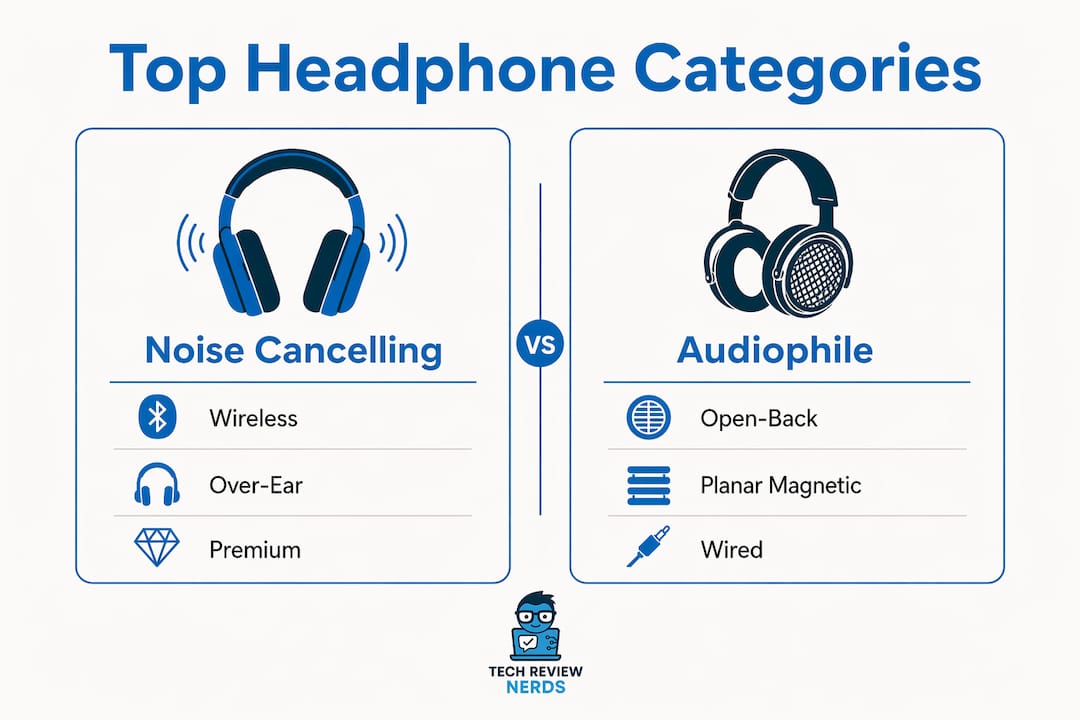
Best noise-cancelling wireless: Sony WH-1000XM6 and Bose QuietComfort Ultra Headphones (2nd Gen) trade blows at the top. The Sony edges ahead on adaptive features and battery life; the Bose wins on sheer silence.

Best audiophile open-back: Sennheiser HD600/650 remains the reference standard around $500, with the HD 660S2 offering a modern refinement of that same neutral voice. The Sennheiser HD800 sits above both for critical listening with a wider soundstage than almost anything else at its price.
Best wireless earbuds: Apple AirPods Pro 3 for iOS users, full stop. The spatial audio integration is genuinely seamless. For Android, the EarFun OpenJump punches well above its price.
Best planar magnetic: Hifiman HE600 for budget entry, Meze Audio Empyrean 2 for the summit.
Best studio monitoring: Sony MDR-7506 and Austrian Audio The Composer both earn their place in professional environments.
| Model | Best For | Price Tier | Type | Noise Cancellation | Wired/Wireless | Sound Profile | Comfort |
|---|---|---|---|---|---|---|---|
| Sony WH-1000XM6 | Travelers/commuters | $$$$ | Over-ear | Active (industry-leading) | Wireless | Balanced/warm | Excellent |
| Bose QuietComfort Ultra (2nd Gen) | Long-haul ANC users | $$$$ | Over-ear | Active (quietest) | Wireless | Balanced | Excellent |
| Apple AirPods Pro 3 | Apple ecosystem | $$$ | In-ear | Active | Wireless | Neutral/spatial | Very Good |
| Sennheiser HD600/650 | Critical listening | $$$ | Over-ear | None (open-back) | Wired | Neutral/reference | Excellent |
| Sennheiser HD800 | Audiophile flagship | $$$$ | Over-ear | None (open-back) | Wired | Analytical/wide | Very Good |
| Beyerdynamic DT770 | Studio monitoring | $$ | Over-ear | Passive (closed-back) | Wired | V-shaped/rich | Excellent |
| Sony MDR-7506 | Pro monitoring | $$ | Over-ear | Passive (closed-back) | Wired | Neutral/detailed | Good |
| Hifiman HE600 | Budget planar | $$ | Over-ear | None (open-back) | Wired | Smooth/relaxed | Good |
| Meze Audio Empyrean 2 | Summit audiophile | $$$$ | Over-ear | None (open-back) | Wired | Holographic | Excellent |
| EarFun OpenJump | Everyday wireless | $ | In-ear | None | Wireless | Balanced | Good |
| Beats Powerbeats Pro 2 | Active/sports | $$$ | In-ear | None | Wireless | Bass-forward | Very Good |
| Shokz OpenRun Pro 2 | Fitness/outdoor | $$ | Bone conduction | None | Wireless | Open/natural | Excellent |
| H2O Audio Tri 2 | Swimming/water sports | $$ | In-ear | None | Wired/Wireless | Balanced | Good |
| Anker Soundcore Space 2 | Budget wireless ANC | $ | Over-ear | Active | Wireless | Spatial/warm | Good |
- The Sony WH-1000XM6 and Bose QuietComfort Ultra (2nd Gen) both offer 24–30 hours of battery life with ANC active, making them the clear picks for travel.
- Open-back designs like the HD600/650 and HD800 deliver a wider, more natural soundstage but leak sound freely, limiting them to quiet listening rooms.
- Planar magnetic headphones (Hifiman, Meze, Audeze) tend to offer lower distortion and extended treble compared to dynamic drivers, at the cost of weight and price.
- Bone conduction (Shokz OpenRun Pro 2) and waterproof options (H2O Audio Tri 2) serve niche but real use cases that conventional headphones cannot cover.
Table of Contents
- Detailed expert reviews of the top headphone models
- What you need to know about headphone types and technology
- How to choose headphones that actually fit your life
- How Techreviewnerds evaluates headphones: the methodology behind the reviews
- Techreviewnerds: independent tech reviews beyond headphones
- FAQ
- Key Takeaways
Detailed expert reviews of the top headphone models
The wireless ANC leaders
The Sony WH-1000XM6 is the most refined version of Sony’s flagship ANC line. Adaptive sound control reads your environment and adjusts in real time, and the multipoint Bluetooth connection handles two devices simultaneously without drama. I think it’s the most complete wireless headphone on the market for most people. The Bose QuietComfort Ultra Headphones (2nd Gen) counters with what I’d call the quietest listening experience available. Its “Quiet Mode” is genuinely remarkable for plane travel. Sound is balanced rather than exciting, which suits long sessions well.
The Sennheiser Momentum 5 Wireless and Bowers & Wilkins PX8 S2 occupy the fashion-forward premium tier. The Momentum 5 delivers a refined, balanced sound with a polished exterior; the PX8 S2 brings adaptive ANC and high-fidelity drivers in a luxury build that feels closer to a fashion accessory than a tech product. The Apple AirPods Max 2 belongs here too, with spatial audio and seamless iOS handoff that no Android equivalent can match.
The JBL Tour One M2 and Anker Soundcore Space 2 are the value picks in the wireless ANC over-ear category. Neither matches Sony or Bose on raw ANC performance, but both offer respectable noise reduction at a fraction of the price. The Soundcore Space 2’s spatial audio features at its price point are genuinely surprising.
The Sony 1000X The Collexion is a limited luxury edition of the XM line with customizable tuning and exclusive materials. It’s for buyers who want personalization alongside performance, not a different headphone in any technical sense.
The audiophile open-back tier
The Sennheiser HD600/650 is the reference point against which most open-back headphones are measured. Around $500, it offers a neutral, natural sound that reveals exactly what’s in a recording without flattering or punishing it. I’ve returned to it repeatedly as a calibration point when evaluating other models. The Sennheiser HD 550 sits just below it with a similarly airy presentation at a lower price, while the Sennheiser HD 660S2 refines the formula with improved build quality and a slightly warmer tonal balance.
The Sennheiser HD800 is in a different league for soundstage width. Its analytical clarity can feel almost surgical, which is a feature for mastering engineers and a potential drawback for casual listening. Pair it with the Fosi Audio i5 Rev2 desktop amplifier and the combination punches well above its combined price.
HarmonicDyne Baroque and OMNE Hendeka represent newer open-back designs worth attention. The Baroque’s large planar drivers produce an airy, precise sound that competes with headphones costing significantly more. The Hendeka prioritizes comfort and soundstage in a design that feels genuinely different from the usual suspects.
Auribus Acoustics Sierra is a newer name that deserves more attention than it gets. High-resolution drivers and a comfortable build make it a strong open-back option for listeners who want spaciousness without the HD800’s price tag.
Closed-back and studio monitoring
The Beyerdynamic DT770 has been a studio staple for decades. Its closed-back design delivers excellent passive isolation, and the comfort over long sessions is hard to beat. The 250-ohm version needs a proper amplifier; the 80-ohm variant works fine from a laptop or interface. The Sony MDR-7506 is the other perennial studio choice: neutral, detailed, and durable enough to survive years of daily professional use.
Dan Clark Audio AEON CORE and Dan Clark Audio Noire X bring premium closed-back performance to the audiophile market. The AEON CORE’s weight-optimized design makes it unusually comfortable for extended sessions; the Noire X adds luxurious materials and a more refined sound signature. The DCA EXPANSE is the most ambitious of the DCA closed-back lineup, delivering an open-like soundstage in a sealed design, which is a genuinely difficult engineering achievement. The Dan Clark Audio DCA E3 rounds out the range with a hybrid dynamic driver configuration for listeners who want energetic impact alongside isolation.
ZMF Atrium Closed and Meze Audio ELITE are the handcrafted luxury picks in this category. ZMF’s wooden enclosure contributes a warmth and resonance that synthetic materials rarely replicate. The ELITE pairs luxurious materials with excellent driver tuning for a closed-back experience that doesn’t feel like a compromise.
Austrian Audio The Composer is the studio monitoring pick for engineers who want precision without the vintage character of the DT770 or MDR-7506. Its accuracy and robust build are its defining traits.
Meze Audio 99 Classics V2 and Meze Audio 105 AER serve different ends of the Meze portable lineup. The 99 Classics V2 offers warm, musical sound in a vintage-styled package; the 105 AER uses aluminum construction for a stronger bass response and better portability.
Planar magnetic headphones
Planar magnetic drivers spread the signal across a thin membrane rather than a cone, which typically reduces distortion and extends treble response. The trade-off is weight and, often, price.
Hifiman HE600 is the entry point: affordable, smooth, and a genuine introduction to what planar magnetic technology sounds like. Hifiman Arya Unveiled steps up with larger drivers, richer bass, and higher resolution. The Hifiman HE1000 Unveiled is Hifiman’s flagship statement, with an expansive soundstage and precise imaging that few headphones at any price can match. Hifiman Mini Shangri La offers excellent dynamics in a smaller form factor for listeners who want planar performance without the full-size weight.
Audeze Maxwell 2 is the wireless planar option, merging audiophile driver technology with Bluetooth convenience. It’s a meaningful engineering achievement, though DSP embedded in wireless headphones shapes the perceived sound in ways that differ from a pure wired transducer output.
HEDD Audio HEDDphone D1 targets mastering engineers specifically. Its exceptional clarity and dynamic range make it a professional tool first and a listening headphone second.
Meze Audio Empyrean 2 is the summit of the Meze lineup: holographic sound, innovative driver design, and a natural soundstage that makes recordings feel three-dimensional. Abyss DIANA MR and Abyss Headphones Diana DZ push into electrostatic territory, with the Diana DZ offering crystal-clear resolution through electrostatic driver technology. The Abyss JOAL is the ultra-high-end collector’s piece in the Abyss range.
ZMF handcrafted headphones
ZMF Headphones occupies a unique position: handcrafted wooden enclosures, artisanal build quality, and sound tuned by a small team with a clear sonic philosophy. The ZMF Headphones Bokeh Open delivers natural timbre and warm tonal balance from its wooden ear cups. The ZMF Headphones ORI 3.0 follows the same philosophy with a signature warm sound. The ZMF Headphones Tessidera is a limited-edition piece with hand-finished wood and a nuanced sound signature for collectors. All three reward listeners who value the craft behind the product as much as the performance.
In-ear monitors and earbuds
FiiO FT1 Pro and FiiO FD3 Pro represent FiiO’s IEM range. The FT1 Pro uses hybrid drivers for expansive sound staging; the FD3 Pro delivers balanced tuning with detailed mids and treble. FiiO JT7 and FiiO FT7 are the over-ear entries from FiiO, both offering wide frequency response and strong value for detail-focused listeners.
Moondrop Para and Moondrop Skyland are the balanced armature picks for budget-conscious buyers. The Para offers excellent price-to-performance for accurate in-ear sound; the Skyland’s hybrid driver synergy delivers a wider soundstage at a mid-budget price. Linsoul Tin HiFi T4 is another strong budget IEM with a hybrid driver setup that outperforms its price.
Apple AirPods Pro 3 leads the true wireless category for iOS users. Spatial audio and seamless device switching are its strongest arguments. EarFun Clip and EarFun OpenJump are the value picks: the Clip offers an IPX rating and solid battery life at a budget price; the OpenJump delivers balanced audio with a stable wireless connection for everyday listeners. Baseus Inspire XH1 adds fast USB-C charging to the budget wireless mix.
Beats Powerbeats Pro 2 is the sports earbud of choice for Apple users: sweat-resistant, secure ear hook design, and bass-forward tuning that suits workouts. ES Lab ES-2a rounds out the IEM tier with unique driver technology and a smooth frequency response for listeners who prioritize engineering precision.
What you need to know about headphone types and technology
Understanding the core design choices makes every headphone review more useful. Here’s what actually matters.
Form factor
Over-ear (circumaural) headphones enclose the ear completely. They generally offer the best soundstage, the most comfort for long sessions, and the most room for driver engineering. The trade-off is bulk.
On-ear (supra-aural) headphones rest on the ear rather than around it. More portable than over-ears, but the pressure on the ear can cause fatigue over long sessions.
In-ear monitors (IEMs) sit inside the ear canal and form a seal. That seal is critical: it dramatically improves passive isolation and bass response, but a poor fit undermines both. IEMs are the most portable option and currently the most actively developed segment of the audiophile market.
Open-back vs. closed-back
Open-back headphones allow air and sound to pass through the ear cups, creating a wider, more natural soundstage. They’re ideal for quiet rooms where you want music to feel expansive and realistic. The downside is that they leak sound in both directions, making them unsuitable for commuting or shared spaces.
Closed-back headphones seal the ear cup, blocking ambient noise and preventing sound leakage. The soundstage often feels narrower, but the isolation is genuinely useful in noisy environments. For recording musicians who need to monitor without bleed, closed-back is the only practical choice.
Connectivity: wired vs. wireless and codec matters
Wired connections offer zero latency and consistent signal quality without battery dependency. For audiophiles and studio professionals, wired remains the reference standard. High-impedance wired headphones (above 80 ohms) typically benefit from a dedicated amplifier.
Wireless headphones introduce Bluetooth codecs as a variable. LDAC reaches 990 kbps and is the best option for Android users streaming high-resolution audio. AAC at 256 kbps is the practical ceiling for iOS. aptX Low Latency reduces audio delay to around 40ms, which matters for gaming and video. Buying LDAC headphones for an iPhone without a compatible dongle is a common and avoidable mistake.
Pro Tip: Check your source device’s supported codecs before buying wireless headphones. An LDAC headphone paired with an AAC-only source will sound no better than a cheaper Bluetooth option.
Noise cancellation, battery life, and comfort
Active Noise Cancellation (ANC) uses microphones and signal processing to counteract ambient sound. It’s most effective against consistent low-frequency noise like airplane engines and air conditioning. It’s less effective against sudden, high-frequency sounds.
Battery life in wireless over-ears typically runs 24–30 hours with ANC active at the premium tier. Earbuds run 8–24 hours including case charges. Tiny earbud batteries degrade after roughly three years of regular charge cycles, which is worth factoring into long-term value.
Clamping force, ear pad seal, and user anatomy all affect bass response and comfort in ways that measurements don’t capture. A headphone that measures beautifully on a test rig may feel uncomfortable or sound thin on your specific head. This is why fit testing before buying matters more than any spec sheet.
How to choose headphones that actually fit your life
The most expensive headphone is not the best headphone. The best headphone is the one you reach for without thinking. Here’s how to get there.
Step 1: Identify your primary listening environment. Where do you spend 80 percent of your listening time? A quiet home office favors open-back wired headphones. A daily commute or open-plan office demands ANC wireless. The gym calls for secure-fit earbuds with an IPX rating.
Step 2: Choose your form factor. Over-ear for immersion and long sessions. In-ear for portability and isolation. Bone conduction (Shokz OpenRun Pro 2) if you need situational awareness during outdoor activity.
Step 3: Decide on connectivity. Wired if you want the highest fidelity and don’t mind the cable. Wireless if freedom of movement matters more than absolute audio quality.
Step 4: Set a realistic budget.
- Under $50: basic wireless earbuds with decent sound (EarFun Clip, Baseus Inspire XH1)
- $150–$350: premium ANC and advanced codecs (JBL Tour One M2, Sennheiser Momentum 5 Wireless)
- Above $350: audiophile and professional grade with specialized drivers (Sennheiser HD600/650, Beyerdynamic DT770, Hifiman HE600)
Step 5: Check for must-have features. Multipoint Bluetooth for connecting two devices? IP rating for gym use? Foldable design for travel? These details narrow the field quickly.
Step 6: Try before you buy, or verify the return policy. Fit is subjective. What feels comfortable to one person feels tight or loose to another.
Common mistakes to avoid:
- Paying for high-end ANC when you primarily listen in a quiet home office where passive isolation is enough
- Buying high-impedance headphones (250 ohm Beyerdynamic DT770) without a dedicated amplifier
- Ignoring codec compatibility when choosing wireless headphones for a specific device ecosystem
- Overlooking battery degradation as a long-term cost factor for earbuds
Pro Tip: Before committing to any wireless headphone, check whether the manufacturer offers ear pad replacements and battery service. A $400 headphone with no replacement parts available is a $400 disposable.
For a broader look at wireless headphone alternatives across different price points, Techreviewnerds has a dedicated roundup worth checking before you finalize a decision.
How Techreviewnerds evaluates headphones: the methodology behind the reviews
Trust in a headphone review comes from transparency about how the evaluation was conducted. Here’s what rigorous testing actually looks like, and what Techreviewnerds applies when assessing any model.
Trusted reviewers combine expert listening panels, standardized test tracks, frequency response measurements, and durability testing to produce impartial evaluations. A five-person listening panel using specific music genres across multiple sessions catches the kind of fatigue and coloration that a single reviewer on a single day will miss.
Frequency response testing measures a headphone’s output from 20 Hz to 20 kHz. Flat response is not always the goal: professional testing uses targets like the Harman curve, developed from large-scale listener preference research, and applies smoothing techniques to make graphs interpretable rather than raw and jagged. A headphone that tracks the Harman target closely tends to sound balanced to most listeners, though individual hearing variation means no target is universal. You can overlay any headphone’s measured curve against the Harman target at squig.link before you buy.
The hands-on vs. specs distinction matters enormously. A headphone can measure well and still feel uncomfortable after 90 minutes, or sound congested on complex orchestral passages despite a flat frequency response graph. Real-world testing catches what lab measurements miss.
Key evaluation criteria Techreviewnerds applies:
- Frequency response: measured against the Harman target with smoothing applied for meaningful interpretation
- ANC performance: tested in consistent ambient noise environments, not just manufacturer claims
- Battery life: measured under real-use conditions with ANC active at moderate volume
- Comfort: assessed across multiple session lengths, noting clamping force and ear pad material
- Build quality: physical stress testing and material assessment for long-term durability
- Codec performance: tested on both Android (LDAC) and iOS (AAC) source devices for wireless models
- Microphone quality: speech-to-noise ratio tested in realistic noisy environments for headsets
Understanding frequency balance is particularly useful when interpreting review graphs. A peak in the 2–5 kHz range, for example, tends to add perceived clarity but can cause listening fatigue. A roll-off below 60 Hz means the headphone won’t reproduce the lowest bass frequencies convincingly.
One thing I want to be direct about: DSP in wireless headphones fundamentally shapes how they sound, separate from the raw transducer output. Comparing a wireless headphone to a wired one on sound quality alone, without accounting for the firmware processing involved, produces misleading conclusions. Techreviewnerds accounts for this in every wireless review.
Techreviewnerds: independent tech reviews beyond headphones
If you’ve found this guide useful, Techreviewnerds publishes the same kind of no-nonsense, hands-on evaluation across a much wider range of tech. The site’s approach is straightforward: real testing, no paid placements, and recommendations based on what actually performs rather than what has the biggest marketing budget.
For readers who are also in the market for a laptop, the tech product reviews hub is a good starting point. Techreviewnerds covers everything from budget productivity machines to high-end creative workstations with the same measurement-plus-real-world methodology described in this guide. If you want side-by-side comparisons rather than individual reviews, the product comparisons section is built specifically for that.
The site is updated regularly, which matters in a market where firmware updates, price drops, and new releases change the competitive picture every few months. Check back before any major purchase.
FAQ
What are the best noise-cancelling headphones in 2026?
The Sony WH-1000XM6 and Bose QuietComfort Ultra Headphones (2nd Gen) lead the category, both offering 24–30 hours of battery life with ANC active and industry-leading noise reduction for travel and commuting.
Are wired headphones better than wireless for sound quality?
Wired connections deliver zero latency and consistent high-fidelity output, making them the reference standard for audiophiles and studio professionals. Modern wireless headphones using LDAC at 990 kbps close the gap significantly for casual listening, but wired remains superior for critical work.
What headphones should I buy on a budget?
Under $50, the EarFun Clip and Baseus Inspire XH1 offer reliable wireless audio with decent battery life. The Hifiman HE600 delivers genuine planar magnetic performance, and the Beyerdynamic DT770 is the go-to closed-back studio option.
How do open-back and closed-back headphones differ?
Open-back headphones produce a wider, more natural soundstage but leak sound in both directions, limiting them to quiet rooms. Closed-back headphones seal the ear cup for better isolation and stronger perceived bass, making them the practical choice for commuting, recording, and shared spaces.
Does headphone fit really affect sound quality?
Yes, significantly. Clamping force, ear pad seal, and ear anatomy all affect bass response and overall sound in ways that measurements on a test rig don’t capture. A headphone that measures well may sound thin or boomy on your specific head if the seal is poor, which is why trying before buying, or checking return policies, is worth the effort.
Key Takeaways
The best headphone for you is determined by listening environment and use case, not by price or specification count alone.
| Point | Details |
|---|---|
| ANC wireless leaders | Sony WH-1000XM6 and Bose QuietComfort Ultra (2nd Gen) both deliver 24–30 hours of battery life with active noise cancellation. |
| Open-back for home listening | Sennheiser HD600/650 is the reference standard around $500 for neutral, critical listening in quiet environments. |
| Codec compatibility matters | LDAC reaches 990 kbps for Android; AAC at 256 kbps is the iOS ceiling — match your codec to your source device before buying. |
| Fit affects sound as much as specs | Clamping force and ear pad seal change bass response and comfort in ways lab measurements don’t capture; always verify return policies. |
| Techreviewnerds for independent reviews | Techreviewnerds applies hands-on testing and measurement-based methodology across headphones and broader tech, with no paid placements influencing recommendations. |