
For most active, on-the-go listeners, wireless earbuds are the smarter pick. For long, focused sessions where sound immersion matters, over-ear headphones usually win. That’s the short answer, and it holds up across most real-world scenarios I’ve evaluated.
Here’s what shapes that recommendation:
- Portability vs. immersion: Earbuds slip into a pocket and stay put during a run. Over-ear headphones deliver a wider soundstage and deeper bass that earbuds rarely match at the same price.
- Long-session comfort: Over-ear headphones distribute pressure across the skull rather than into the ear canal, making them the better choice for four-plus hour sessions.
- Call performance: Most earbuds handle calls well enough for commuting, but a dedicated boom mic or near-ear array on a headset gives noticeably cleaner voice pickup in noisy environments.
- Hearing safety: The Cleveland Clinic notes that earbuds deliver audio directly into the ear canal, which can intensify sound pressure at the eardrum. Keeping volume below 85 dB is the standard guidance from auditory health authorities.
Table of Contents
- How do wireless earbuds and headphones compare side by side?
- What actually changes what you hear: drivers, seal, and codecs
- Comfort and fit: how long can you actually wear them?
- Portability and battery: size and power in daily use
- Noise control and hearing safety: ANC, passive isolation, and safe listening
- Call quality, microphones, and latency for video calls and gaming
- Durability and active use: sweat resistance, fit, and staying put
- Price and value: what to expect at each budget level
- Which should you choose? A decision flow and checklist
- Key Takeaways
- The case for slowing down before you buy
- Useful sources and further reading
- FAQ
How do wireless earbuds and headphones compare side by side?
| Dimension | Earbuds | Over-ear headphones |
|---|---|---|
| Sound quality | Good to excellent (tip-dependent) | Generally superior bass and soundstage |
| Comfort (long sessions) | Canal pressure after 1–2 hours | Better for 4+ hours; heat buildup after 3+ hours |
| Portability | Pocket-sized with charging case | Bulky; requires a bag |
| Battery (per charge) | Typically 6–10 hours | Typically 20–40 hours |
| Total battery (with case) | Up to 30–36 hours | Single-unit only |
| Noise control | ANC or passive seal | ANC or passive isolation; often stronger |
| Call quality / mic | Adequate; placement varies | Better with boom mic or headset array |
| Latency | Low; varies by codec | Low; varies by codec |
| Durability / IP rating | IPX4–IPX7 common for sport models | Rarely rated; more fragile in rain |
| Price range | $20–$300+ | $30–$400 |
The two trade-offs that matter most:
- Portability vs. immersion: Earbuds win every time you need to move freely. Headphones win when you want the audio to feel like it surrounds you.
- On-the-go convenience vs. long-session comfort: Earbuds are fine for a 45-minute commute. A four-hour work session is where over-ear designs earn their keep.
Who each category suits best:
- Earbuds: commuters, gym-goers, casual listeners who prioritize portability
- Over-ear headphones: remote workers, audiophiles, travelers on long flights, gamers who want immersive sound
- Either works: casual home listening, video calls with a quiet background, podcast listeners
Stat to know: More than 1.1 billion young people worldwide face risk from unsafe personal audio device use, making volume management a priority regardless of which category you choose.
What actually changes what you hear: drivers, seal, and codecs
Driver size is the starting point. Over-ear headphones typically use 40mm or larger drivers, which move more air and produce deeper, more natural bass at lower listening volumes. Earbuds work with drivers in the 6–12mm range, which is a real physical constraint on low-end extension and dynamic range.
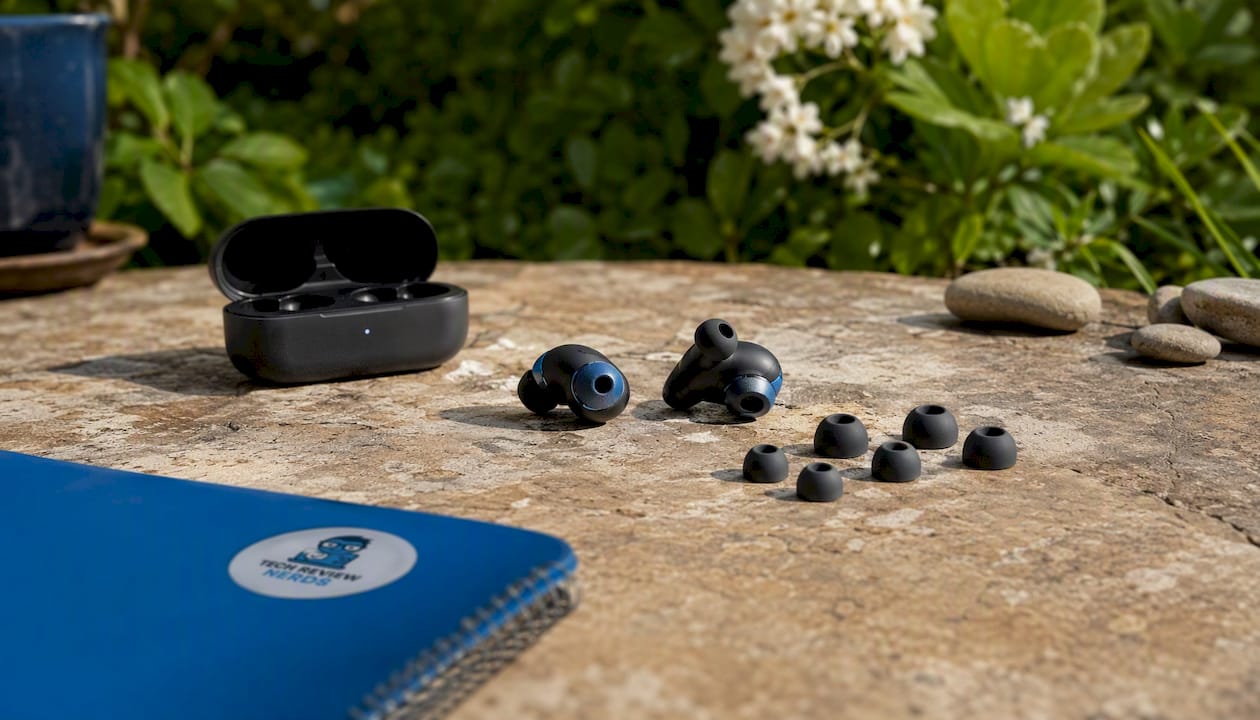
The in-ear seal changes the equation significantly, though. A well-fitted silicone or foam tip creates a pressure chamber that boosts perceived bass. Swap to a poorly fitting tip and the low end collapses. This is why two people using the same earbuds can have completely different impressions of the sound.
Codecs matter, but probably less than most buyers expect. SBC is the Bluetooth baseline. AAC performs well on Apple devices. The aptX family (aptX, aptX HD, aptX Adaptive) and Sony’s LDAC offer higher bitrates for Android users with compatible sources. The newer LC3 codec, part of the Bluetooth LE Audio standard, promises better efficiency at similar quality. In practice, the codec ceiling is only relevant if your source device supports it, so check compatibility before treating codec specs as a differentiator.
HP Tech Takes notes that high-end in-ear monitors can approach the sound quality of premium over-ear headphones, but typical mass-market earbuds trade off driver size and headroom. The gap closes as you move up in price.
Where earbuds typically fall short on sound:
- Sub-bass extension below 40 Hz
- Wide, open soundstage (most earbuds sound “in-head” by comparison)
- Dynamic range at higher volumes without distortion
Comfort and fit: how long can you actually wear them?
Canal pressure is the limiting factor for earbuds. After roughly 60–90 minutes of continuous wear, many people notice discomfort or a plugged feeling, especially with silicone tips. Foam tips often help by conforming to the canal shape and reducing the pressure needed to maintain a seal.
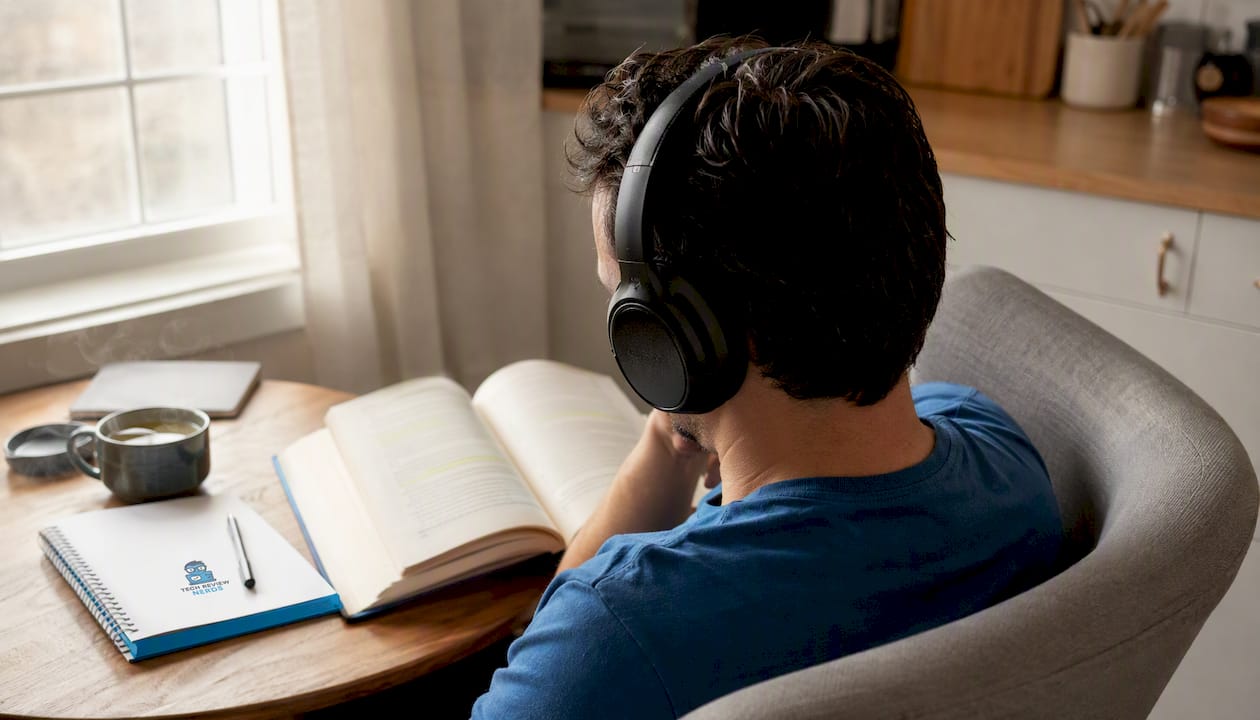
Over-ear headphones shift the load to the skull and jaw area via clamping force. That’s more comfortable for extended sessions, but it introduces its own issues: heat buildup inside the ear cup after three-plus hours, and headache risk from tight clamp on narrower heads. NearHub’s ergonomic guidance recommends targeting headphones under roughly 200 grams with large ear cups and breathable memory-foam cushions for multi-hour workdays.
Hygiene is worth factoring in here too. TheHealthy reports that earbuds can harbor high bacterial loads and trap moisture in the ear canal, raising the risk of otitis externa if not cleaned regularly. Wipe tips after every use and replace foam tips every few weeks.
Practical thresholds:
- Under 2 hours: earbuds are fine for most people
- 2–4 hours: personal preference; foam tips help earbuds, breathable cushions help headphones
- 4+ hours: over-ear headphones are generally more comfortable
Pro Tip: Before committing to earbuds, test at least three tip sizes. The right fit changes both comfort and sound quality more than any spec on the box.
Portability and battery: size and power in daily use
The charging case is the real battery story for earbuds. A typical pair delivers 6–10 hours per charge, with the case adding two to three full top-ups for a combined total of 24–36 hours before you need a wall outlet. Quick charge is common at mid-range and above: 10–15 minutes in the case often yields an hour or more of playback.
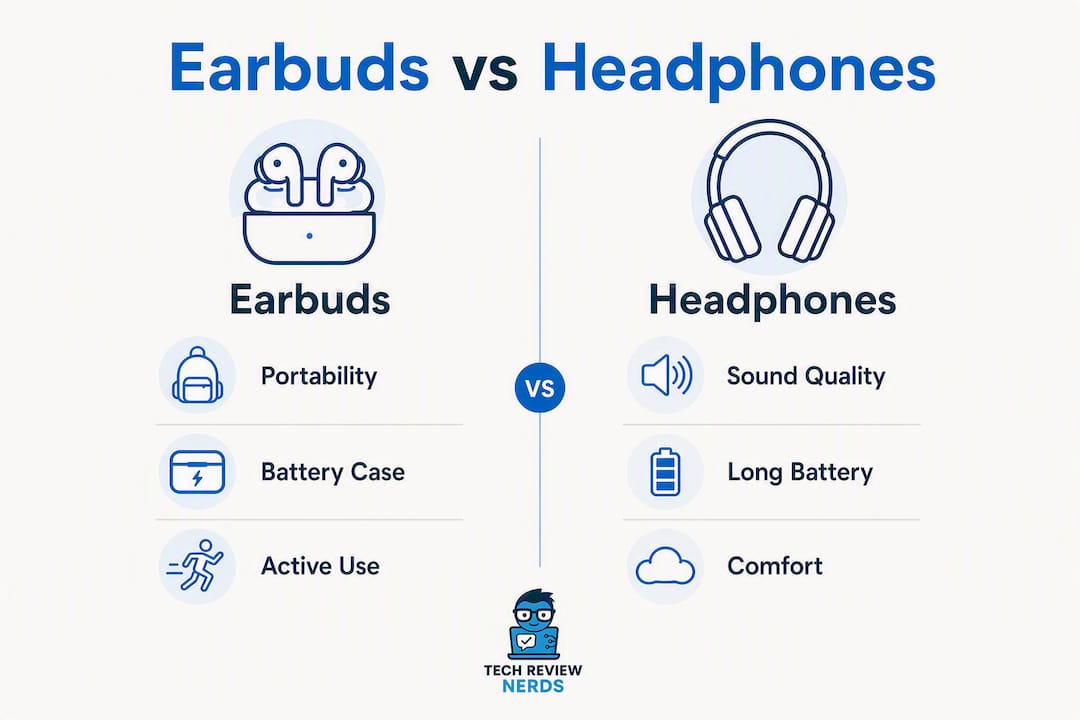
Over-ear headphones skip the case entirely and run 20–40 hours on a single charge. That’s a meaningful advantage for travel or anyone who forgets to charge regularly. The trade-off is size. A pair of over-ear headphones needs a bag; earbuds fit in a jacket pocket.
For fitness use specifically, TheHealthy’s reporting confirms that earbuds with secure-fit features and IPX sweat ratings are the more practical choice over over-ear headphones during exercise.
Real-world portability trade-offs:
Quick stat: Most mid-range earbuds now offer at least 24 hours of total battery life when the charging case is included, making multi-day trips without a charger realistic.
Noise control and hearing safety: ANC, passive isolation, and safe listening
Active noise cancellation (ANC) uses microphones to sample ambient sound and generate an opposing signal that cancels it out. Passive isolation works by physically blocking sound with the ear cup seal or in-ear tip. Both approaches reduce the urge to raise volume in loud environments, which is where the hearing-safety benefit comes in.
Cumulative exposure above 85 dB is the primary hearing danger, and earbuds intensify this risk because they deliver audio directly into the ear canal. Over-ear headphones, especially with good passive isolation or ANC, let you hear clearly at lower volumes. A Springer Nature mini-review identifies personal audio device use as a growing public health concern and recommends the 60/60 rule: no more than 60% of maximum volume for no more than 60 minutes at a stretch.
Practical safe-listening habits:
- Use your device’s built-in volume limiter or a volume-capping app
- Choose ANC in loud environments rather than turning up the volume
- Take listening breaks of at least 5 minutes per hour during extended sessions
- Clean earbud tips regularly to maintain a proper seal (a poor seal leads to volume creep)
Pro Tip: Mayo Clinic Health System’s practical test is simple: if someone nearby can hear your audio, or you have to raise your voice to be heard, your volume is above safe limits. Lower it.
For a deeper look at how ANC performs across specific over-ear models, the Sony WH-1000XM5 vs Bose QuietComfort Ultra comparison on Techreviewnerds breaks down real-world cancellation performance in detail.
Call quality, microphones, and latency for video calls and gaming
Microphone placement is the biggest variable. Earbuds place mics on the bud itself, close to the mouth but still several inches away and exposed to wind. Over-ear headsets with a boom mic position the element within an inch of the lips, which produces noticeably cleaner voice pickup and better background-noise rejection.
For most commuting calls and casual video meetings, earbuds perform well enough. The gap becomes obvious in open-plan offices or outdoor environments, where wind noise and ambient sound bleed into the signal. Remote workers doing back-to-back video calls will generally get better results from a headset with a dedicated boom.
Latency matters for gaming and video editing. Standard Bluetooth SBC introduces 100–200ms of delay, which is perceptible when gaming or syncing audio to video. aptX Low Latency and aptX Adaptive reduce this to around 40ms or less. For competitive gaming, a wired connection or a dedicated 2.4 GHz wireless gaming headset eliminates the issue entirely. The Logitech Astro A50 review on Techreviewnerds covers how a dedicated gaming headset handles both latency and mic clarity in practice.
By use case:
- Remote-work meetings: — Over-ear headset with boom mic gives the cleanest voice signal; earbuds are acceptable in quiet rooms.
Durability and active use: sweat resistance, fit, and staying put
IP ratings tell you how much protection a device has against water and particulates. For audio gear, the relevant rating is usually IPX followed by a number: IPX4 means splash-resistant from any direction, IPX7 means submersible to one meter for 30 minutes. Most sport earbuds carry IPX4 or IPX5, which is adequate for heavy sweating and light rain. If you swim or train in heavy rain regularly, look for IPX7 or higher.
Over-ear headphones rarely carry IP ratings. Most are not designed for sweat exposure, and moisture can degrade the cushion materials and internal components over time. For workouts, earbuds are the practical choice.
Fit retention is equally important. Wings and fins keep earbuds anchored during lateral movement; without them, standard earbuds tend to work loose during running or high-intensity training. Test fit by shaking your head side to side before buying.
| Feature | Sport earbuds | Over-ear headphones |
|---|---|---|
| IP rating | IPX4–IPX7 common | Rarely rated |
| Sweat resistance | Yes (designed for it) | No |
| Fit during movement | Wings/fins help retention | Slides or falls during exercise |
| Cushion durability | Tips replaceable | Pads degrade with sweat exposure |
Durability checklist for active buyers:
- Confirm IP rating matches your activity (IPX4 for gym, IPX7 for outdoor/rain)
- Check that replacement tips or wings are available and affordable
- Look for a reinforced cable connection point on the charging case
- Avoid models with fabric mesh grilles if you sweat heavily
Price and value: what to expect at each budget level
Entry level (under $50): Basic Bluetooth 5.0, SBC/AAC codecs, no ANC, and battery life in the 4–6 hour range per charge. Sound quality is functional but not impressive. Earbuds at this tier often skip fit options beyond one or two tip sizes. Headphones at this price tend to be on-ear rather than over-ear, with thinner cushioning.
Mid-range ($50–$150): This is where most buyers find the best value. Earbuds gain ANC, multipoint connection (pairing to two devices simultaneously), and 6–8 hours per charge with a case that adds 20+ more. Headphones at this tier offer 30+ hours of battery, decent ANC, and foldable designs for travel. Microphone quality improves noticeably.
Premium ($150–$300+): Flagship tuning, LDAC or aptX Adaptive support, best-in-class ANC, and premium materials. HP Tech Takes confirms that high-end in-ear monitors can approach over-ear headphone sound quality at this tier. Headphones in this range deliver the most immersive listening experience available in wireless audio.
When to spend more:
- ANC quality scales significantly with price; budget ANC often introduces hiss or artifacts.
- Microphone performance at the premium tier is meaningfully better for professional calls.
- Build quality and warranty coverage improve; cheaper models often lack replaceable parts.
For readers who want product-level picks after deciding on a category, the headphone reviews hub on Techreviewnerds covers options across all three tiers with hands-on testing notes.
Which should you choose? A decision flow and checklist
Decision flow:
- Do you exercise or commute daily? Choose earbuds.
- Do you work from home for 4+ hours with headphones on? Choose over-ear headphones.
- Are you a competitive gamer who needs low latency? Choose a 2.4 GHz gaming headset.
- Do you travel long-haul frequently? Over-ear headphones with ANC block cabin noise more effectively.
- Is portability your top priority? Earbuds, without question.
One-minute pre-purchase checklist:
- Try at least three tip sizes (earbuds) or adjust the headband for even clamping pressure (headphones)
- Check battery life per charge, not just total with case
- Test the mic by recording a voice memo in a noisy environment
- Confirm the IP rating matches your use case
- Check the volume level using the nearby-person test before finalizing your settings
Red flags to walk away from:
- No warranty or a warranty under 12 months
- Only one tip size included with no aftermarket options listed
- Cushion or tip materials that cannot be wiped clean or replaced
- No codec information listed (suggests SBC-only, which limits quality ceiling)
- Charging case with no battery indicator
Pro Tip: If you’re torn between categories, consider your longest daily listening session. That single variable predicts which type will frustrate you first.
If you want curated picks across both categories, Techreviewnerds’ gadgets section keeps recommendations current with hands-on testing notes.
Key Takeaways
Earbuds win on portability and active use; over-ear headphones win on long-session comfort, sound immersion, and call quality, making your daily listening habits the single most reliable guide to which category fits you.
| Point | Details |
|---|---|
| Lifestyle determines the winner | Active and mobile users benefit most from earbuds; long-session listeners gain more from over-ear headphones. |
| Comfort has a time limit | Earbuds cause canal pressure after roughly 1–2 hours; over-ear headphones manage 4+ hours before heat buildup becomes an issue. |
| Hearing safety applies to both | Keep volume below 85 dB and follow the 60/60 rule regardless of which category you choose. |
| Sound quality gap narrows at premium | High-end in-ear monitors can approach over-ear headphone quality, but typical consumer earbuds still trail on bass and soundstage. |
| IP rating matters for workouts | Sport earbuds with IPX4 or higher handle sweat; over-ear headphones are rarely rated and not designed for exercise. |
The case for slowing down before you buy
There’s a tendency in audio buying to chase specs: driver size, ANC depth, codec support. I think that’s the wrong starting point. The more useful question is how you actually spend your listening time across a typical week.
Most people who ask “which is better, earbuds or headphones?” are really asking which one they’ll stop noticing after a few days. That’s a comfort and lifestyle question, not a specs question. Over-ear headphones with 40-hour battery life sound impressive until you realize you hate wearing them on the subway. Earbuds with premium ANC sound like the obvious commuter choice until you’re three hours into a work session and your ears ache.
The hearing-safety angle is also underweighted in most buying conversations. Earbuds are not inherently more dangerous than headphones, but their proximity to the eardrum means volume discipline matters more. Good ANC on either form factor is genuinely protective because it reduces the urge to crank volume in noisy environments. That’s worth paying for.
My honest recommendation: pick the category that fits your longest and most frequent use case, then find the best model within your budget for that scenario. Techreviewnerds covers both categories with hands-on testing, so once you know which direction you’re going, the product comparison guides can take you the rest of the way.
Useful sources and further reading
These sources informed the guidance in this article. Each covers a distinct angle worth exploring if you want to go deeper.
- How Headphones and Earbuds Can Harm Your Hearing — Cleveland Clinic: Covers the 85 dB threshold, sound pressure risks from in-ear devices, and practical volume-limiting recommendations.
- Earbuds and Hearing Loss — Mayo Clinic Health System: Practical safe-listening tests and guidance on volume habits, particularly relevant for younger listeners.
- Personal Audio Devices and Hearing Health — Discover Public Health (Springer Nature): Population-level risk data and the 60/60 rule recommendation from a public health research perspective.
- Earbuds vs. Headphones: Ear Doctors Reveal Which Is Safer — TheHealthy: Expert commentary on hygiene risks, bacterial load, and IP ratings for active use.
- Earbuds vs. Over-the-Ear Headphones — Hearing Health Foundation: Audiology-focused perspective on which form factor poses greater hearing risk and why.
- Audio Approval Workflows for Creators — Audome: Relevant for content creators and streamers evaluating over-ear setups alongside collaboration tools.
FAQ
Which is better, wireless earbuds or headphones?
It depends on your primary use case. Earbuds are better for active, mobile lifestyles; over-ear headphones deliver superior sound immersion and long-session comfort for focused listening.
Are headphones safer for your hearing than earbuds?
Neither is inherently safer, but earbuds deliver audio closer to the eardrum, which can intensify sound pressure. The Cleveland Clinic recommends keeping volume below 85 dB regardless of which type you use.
Why are people moving away from over-ear headphones?
Portability is the main driver. Earbuds fit in a pocket, pair instantly, and handle calls well enough for most situations, making them the practical default for daily commuters and gym users.
What are the main downsides of wireless earbuds?
Canal pressure during extended wear, higher bacterial buildup if not cleaned regularly, and generally smaller drivers that limit bass extension and soundstage compared with over-ear headphones at the same price.
How long can you comfortably wear each type?
Most people find earbuds comfortable for up to 1–2 hours before canal pressure builds. Over-ear headphones are typically comfortable for 4+ hours, though heat buildup inside the ear cup becomes noticeable after three hours of continuous wear.